

Elevated water tank design plays an important role in developing reliable and resilient water distribution systems. Despite advances in pumping technology and automation, elevated water storage remains an efficient method of providing water pressure across municipal, industrial and rural water networks.
While booster pump systems are often considered the default solution for pressure management, elevated tanks provide significant advantages in terms of hydraulic stability, operational resilience, emergency water availability and continued water supply during power interruptions.
The engineering challenge lies in determining when elevated storage is appropriate, how much capacity is required and how high the tank should be positioned to achieve the required system performance.
Elevated tanks operate on a simple hydraulic principle: static head pressure.
As water is stored above the distribution network, gravitational potential energy is converted into pressure within the pipeline system. The pressure generated is directly related to the vertical distance between the water surface and the point of discharge.
Consequently, the required tank elevation is governed by:
The objective is not simply to maximise tank height, but to provide sufficient hydraulic head to maintain the required pressure throughout the system under different operating conditions.
One of the most important advantages of elevated water storage is its ability to provide water without depending entirely on electrical power.
Because an elevated tank uses gravity to generate pressure, water can continue flowing to the distribution network even when local pumps are temporarily offline. The stored water effectively acts as a physical water buffer, maintaining supply and helping to stabilise pressure while the electrical grid or pumping infrastructure recovers.
This provides an important layer of resilience for municipal, rural and remote water networks, where power interruptions can have an immediate impact on pumping capacity.
Without elevated storage, a power outage can quickly lead to a loss of pumping capacity and widespread interruptions to water supply. Elevated tanks provide stored capacity that can bridge this gap, allowing critical water distribution to continue while power is restored.
For this reason, elevated storage can play an important role in designing water infrastructure that is not only hydraulically effective, but also resilient to operational disruptions.
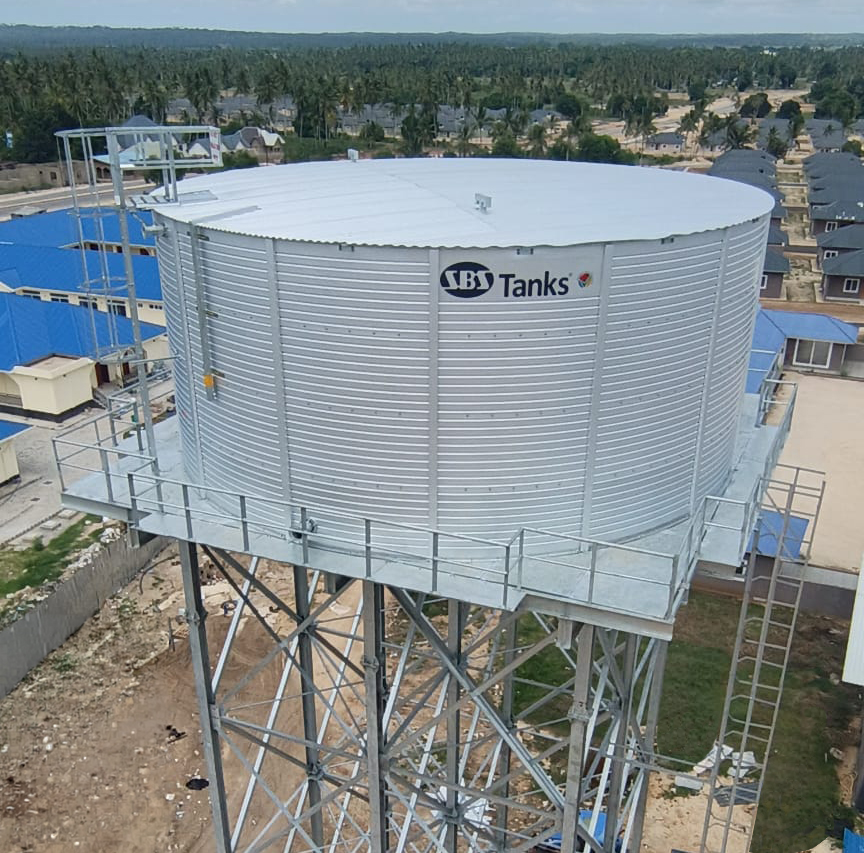
This is one of the most common questions encountered during preliminary design.
The answer depends entirely on the hydraulic requirements of the system.
Engineers typically evaluate:
In many municipal and rural applications, the required pressure determines the stand height long before storage capacity influences the tank design.
For this reason, hydraulic analysis should always precede structural design. The elevation of the tank needs to be determined by the performance requirements of the distribution network rather than simply by the volume of water the tank needs to store.
The decision between elevated storage and booster pumping is often debated during project development.
Booster systems offer flexibility and lower initial structural costs but introduce dependency on electrical infrastructure, mechanical equipment and control systems.
Elevated storage provides:
In practice, many successful water systems utilise a combination of both approaches. Elevated storage can provide baseline pressure and emergency resilience, while booster systems support peak demand conditions where required.
This combination can reduce the system’s reliance on mechanical pumping while maintaining the flexibility required to respond to changing demand.
While the hydraulic principles are straightforward, elevated tank structures introduce significant structural engineering challenges.
Unlike ground-level tanks, elevated systems must transfer the combined weight of the structure and stored water through a tower system into the supporting foundation.
Design considerations typically include:
The tower and tank must therefore be designed as an integrated structural system capable of safely supporting the stored water under the expected environmental and operational loading conditions.
Foundation design is often one of the most critical components of an elevated tank project.
Unlike ground-level tanks, where loads are distributed around the tank perimeter, elevated tanks concentrate substantial vertical and lateral loads through the support structure.
Engineers must evaluate:
Foundation design therefore becomes a multidisciplinary exercise involving both structural and geotechnical engineering considerations.
The supporting foundation must safely transfer the loads generated by the tank, stored water and environmental forces into the ground while maintaining the stability of the overall structure.
Remote and rural projects introduce additional design constraints.
Limited site access, reduced lifting capability, transportation restrictions and challenging ground conditions can all influence the final solution.
In East Africa and other developing regions, elevated storage frequently provides a practical means of delivering reliable water pressure to communities located far from sophisticated pumping infrastructure.
The ability to generate pressure through gravity can be particularly valuable in locations where electrical infrastructure is limited or where interruptions to power supply could otherwise compromise water availability.
Elevated tank design requires more than simply determining storage capacity. The tank elevation, hydraulic requirements, structural system, foundation and operating environment all need to be considered as part of the wider water distribution network.
At SBS Tanks, elevated tank projects are assessed through both hydraulic and structural engineering reviews to ensure the selected solution satisfies operational requirements, environmental loading criteria and constructability considerations.
Ultimately, successful elevated tank design is achieved by balancing hydraulic performance, structural integrity, operational resilience and long-term reliability.
The question is not simply how much water needs to be stored, but how the storage asset contributes to the overall performance and resilience of the water distribution system.
An appropriately designed elevated tank can provide the required pressure through gravity, maintain a valuable reserve during power interruptions and reduce dependence on mechanical pumping. This makes elevated water storage an important consideration for water networks where reliability and continuity of supply are critical.
Elevated water tanks provide reliable water pressure by using gravity, reducing dependence on mechanical pumping and electrical infrastructure. Tank height is determined by hydraulic requirements including system pressure, topography, pipe losses, demand and fire flow. Beyond pressure management, elevated storage acts as a physical water buffer, allowing water to continue flowing during power outages while pumping systems and the electrical grid recover. Structural design must account for wind, seismic and dynamic water loads, tower stability, deflection and foundation forces. By balancing hydraulic performance, structural integrity and operational resilience, elevated tanks can provide reliable, long-term water storage and distribution.
How high should an elevated water tank be?
Tank height is determined by required system pressure, topography, hydraulic losses and service area requirements rather than storage volume alone.
How do elevated tanks create water pressure?
Elevated tanks generate pressure through static head, using gravity to create pressure within the distribution network.
Are elevated tanks better than booster pumps?
Neither solution is universally better. Elevated tanks provide passive pressure and resilience, while booster pumps offer flexibility. Many systems utilise both.
Why are elevated tanks still used today?
Elevated storage remains an efficient method of providing reliable pressure, emergency reserve capacity and operational resilience, particularly in municipal and rural applications.
What structural loads affect elevated tanks?
Engineers must consider wind loading, seismic loading, structural deflection, fatigue loading and foundation forces.
What foundation loads do elevated tanks create?
Elevated tanks generate significant vertical loads, overturning moments and lateral forces that must be transferred safely into the supporting foundation system.
© SBS Holdings 2026