
Wastewater infrastructure is one of South Africa’s most urgent service-delivery challenges. Rapid population growth, urban expansion and ageing municipal networks continue to place pressure on treatment capacity, environmental compliance and community infrastructure.
In this environment, storage is no longer only about holding water. On certain projects, tanks form part of the process itself. This was the case on the Klomac Engineering wastewater treatment project in uMgungundlovu District Municipality, just north of Pietermaritzburg in KwaZulu-Natal. The project was commissioned by Umgeni Water, with Klomac Engineering appointed to build and operate the plant prior to future handover to the local municipality.
The project was completed in June 2025 and SBS Tanks supplied five open-top modular steel-panel tanks for the wastewater treatment process, providing approximately 2.9 ML of installed process capacity:
The purpose of the plant is not potable water production. Its primary design function is to treat wastewater to a level suitable for environmentally safe secondary-treatment discharge, in line with applicable wastewater and effluent quality requirements managed by the Department of Water and Sanitation and relevant local authorities.
For SBS Tanks, the project scope required a different level of project-specific design co-ordination. The tanks were not simply being used as passive storage vessels. They needed to support aeration, decanting and holding functions within Klomac’s broader wastewater treatment process.
SBS’s in-house engineering capability was a key benefit on the project, enabling close collaboration with Klomac Engineering, the process design team and SBS project management to ensure the tank package met its intended wastewater treatment application.
Key technical considerations included:
• Wastewater compatibility, including specialist liner selection and stainless steel wetted fittings.
• Open-top tank configuration to support aeration, decanting and holding functions.
• Aeration pipework interfaces, including base and nozzle penetrations.
• Freeboard, overflow, foundation and load-bearing requirements to support safe operation.
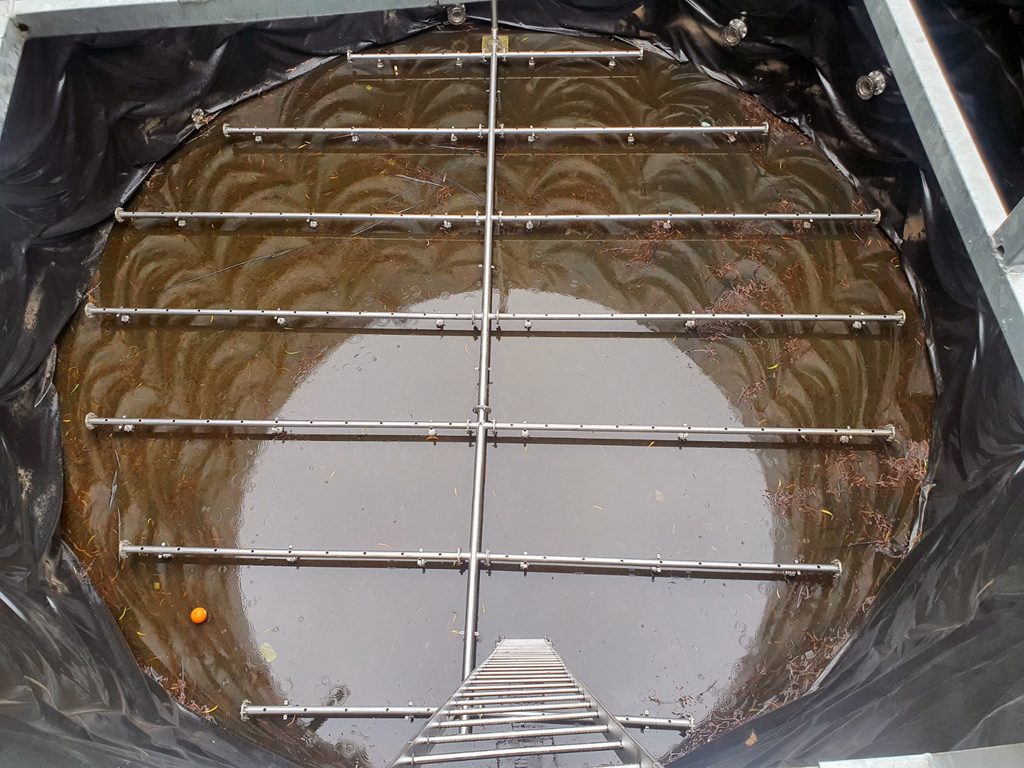
Although the tank shell design remained within SBS’s proven modular steel-panel system, the application required careful review of the components that would come into contact with the stored wastewater.
The liner, fittings and aeration interfaces were central to the design. SBS reviewed the wastewater quality information and worked with Klomac and suppliers to confirm suitable liner and stainless-steel wetted fitting requirements. Because aeration introduces air into the wastewater to support treatment and prevent stagnation, the tanks required more co-ordination than standard storage tanks. Detailed designs around base penetrations, nozzle orientation and interface points allowed Klomac’s process equipment to integrate with the SBS tanks while protecting liner integrity and containment performance.
The project was located in a compact and environmentally sensitive peri-urban area. Space was limited, and the plant had to be delivered within a smaller footprint than a traditional large-scale wastewater treatment works.
This is where modular steel construction offered practical value. The SBS tanks could be manufactured under controlled factory conditions, delivered to site in component form and installed as the civil platforms became available.
The tank package was constructed in stages, aligned with Klomac’s broader construction programme. SBS worked closely with the civil contractor and engineering team to co-ordinate foundation requirements, ring beam preparation, nozzle positions and installation sequencing.
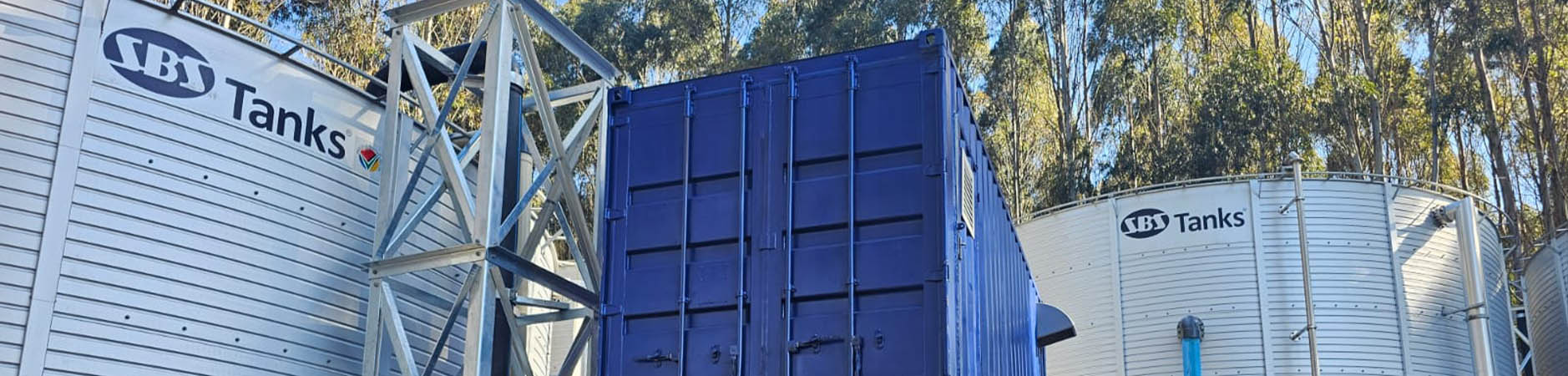
Site logistics also required planning. Because space and laydown security were limited, SBS utilised a 12m container to store the knock-down tank components on site. Materials could then be removed and assembled as required on site, helping to control access, protect components and support an orderly staged build.
Traditional concrete infrastructure remains important in the traditional wastewater sector. However, concrete can require large footprints, extended construction periods, longer curing times and significant civil works before process equipment can become operational making phased project completion almost impossible.
For this project, time was a critical factor. Klomac required a practical way to deliver wastewater process capacity faster than a conventional concrete approach.
SBS’s modular tank package supported the project through:
• In-House Engineering: Close collaboration between SBS Tanks, Klomac and the end-user fast-tracked a suitable solution.
• Speed: factory manufacture and staged installation shortened delivery timelines.
• Cost efficiency: modular steel reduced the capital intensity of the tank package.
• Footprint efficiency: significant process capacity was delivered on a compact site.
• Adaptability: the tanks were configured for aeration, decanting and holding functions.
• Maintainability: components remain accessible for inspection and future intervention.
• Project support: engineering, project management and installation teams worked with Klomac from design review to handover.
“SBS Tanks delivered across the full project – from drawings and technical reviews to site execution and follow-up support. From our side, we can only compliment the team.”
– Sydney Paton, Director, Klomac Engineering Pty Ltd
The broader significance of this project goes beyond one successful wastewater plant in KwaZulu-Natal.
Across South Africa, many municipalities face the same problems: population growth and development have moved faster than bulk wastewater infrastructure. Large permanent treatment works are essential, but they can take years to plan, fund, approve and construct, still leaving an immediate and urgent need for interim treatment facilities to meet current needs.
Compact, modular wastewater treatment plants can help bridge that gap. Where appropriate, they can provide earlier treatment capacity while larger infrastructure is developed around them. This has clear social, environmental and economic value.
Earlier wastewater treatment capacity can help protect rivers, dams and groundwater resources. It can support residential and commercial development. It can reduce pressure on overloaded infrastructure. Most importantly, it can help communities receive critical services sooner than current planning will allow.
Because SBS tanks are modular and bolted, they also offer flexibility for phased or semi-permanent infrastructure. If a plant is later expanded, relocated or replaced by larger civil infrastructure, the tanks can be decommissioned, dismantled and potentially redeployed with far less environmental impact than permanent concrete structures might.
The Klomac Engineering wastewater treatment project demonstrates how SBS Tanks can support infrastructure beyond conventional water storage. In this application, the tanks became part of the wastewater treatment process itself, supporting aeration, decanting and holding within a compact plant.
For SBS Tanks, the project reinforces the value of combining manufacturing capability with engineering support, project management and installation experience. For contractors and infrastructure partners, it shows how modular steel tanks can help overcome time, footprint and budget constraints.
For South Africa, the lesson is broader. As urbanisation accelerates and wastewater infrastructure comes under pressure, proven alternative technologies must be considered by municipalities and delivery partners if the prevailing crisis is to be averted.
For SBS Tanks, projects like Klomac show how modular engineering can help South Africa respond faster to infrastructure pressure, protect the environment and deliver essential services to more communities, sooner.
SBS Tanks manufactures and installs modular bolted steel water storage tanks for municipal, industrial, mining, agricultural and fire protection applications.
With project-specific engineering, controlled manufacturing and experienced installation teams, SBS Tanks delivers water storage infrastructure designed around the operational, environmental and structural requirements of each site.
The Klomac Engineering wastewater treatment project in KwaZulu-Natal used five SBS Tanks with approximately 2.9 ML of process capacity for aeration, decanting and holding.
SBS’s modular steel tank technology helped overcome site constraints, programme pressures and the need for faster delivery, while specialist liners, fittings and engineering ensured compatibility with the wastewater treatment process.
The project demonstrates how modular tanks can provide flexible, space-efficient infrastructure faster than traditional construction, helping address South Africa’s growing wastewater treatment needs.
© SBS Holdings 2026