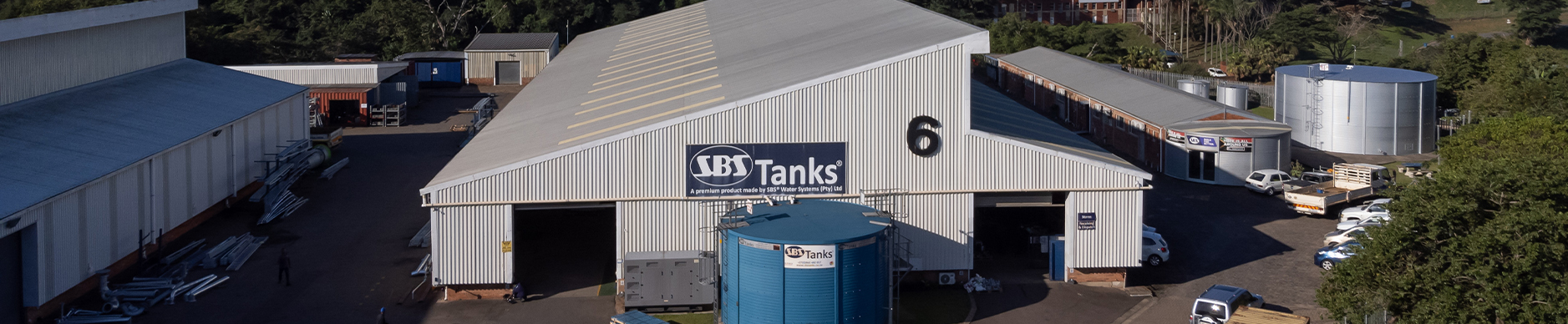

SBS Tanks manufactures core steel water tank components in its ISO-managed Durban facility. Rolling forms steel wall panels, liner manufacturing creates liquid-containment barriers, fabrication produces structural and functional parts, and Boxing & Kitting consolidates them for site installation. Documented controls and digital production information connect the approved tank design to its component set.
Picture a steel water tank standing on a project site. Its curved walls are in place, the roof is above them and the connections are ready to join the water reticulation system. From a distance it appears to be one finished product. In reality, it began as many different manufacturing tasks, carried out by different people, often in different departments of the same factory.
That is what makes a visit to SBS Tanks’ manufacturing facility so revealing. You do not see a completed tank rolling off an assembly line. You see the individual components from which a tank will eventually be assembled: curved steel panels, carefully prepared internal liners, fabricated steelwork, connections and the many smaller items needed to bring them all together as a completed SBS tank.
The journey begins with a defined tank requirement. Engineers establish the configuration and specifications for the intended application. But how does that design move from an engineer’s computer screen to the factory floor, where steel, machinery and skilled production personell bring it to life?
At SBS Tanks, this bridge is supported by Fusion Operations, a digital Manufacturing Execution System (MES) that co-ordinates production activities across the factory. Rather than relying on stacks of paperwork moving between departments, operators use handheld tablets to access relevant job orders, drawings and production information directly from the shop floor.
That link between an engineered design and a physical object is easy to underestimate. A drawing may show a curve, a joint or a structural member as a collection of lines. On the factory floor those lines become a choice of material, a machine operation, an operator’s check and, ultimately, a component someone must install onto a completed SBS Tank.
Behind this transformation is a digitally supported production process. Fusion Operations tracks SBS manufacturing activities and maintains visibility as work progresses through different departments, helping teams work from the information relevant to each tank order.
It is where digital technology, engineering expertise and practical manufacturing skills come together to turn designs into something real.
In the Rolling department, prepared steel panels take on the curvature required for a particular tank diameter. Seen on its own, one panel hardly resembles a storage tank. Put many correctly prepared panels together in successive rings, however, and the circular tank wall begins to make sense.
Operators check the formed panels for correctness and manufacturing accuracy and identify them for the appropriate tank model. There is a practical reason: the installation team is not receiving an anonymous stack of curved steel. It is receiving components identified manufactured to work as parts of a particular SBS Tank.
The steel wall is only one part of the story. For SBS’s lined tank systems, an internal liner provides the liquid-containment structure. A dedicated team prepares the liner from material selected for the storage application and cuts and skillfully welds the sections to suit the tank’s geometry.
It is a striking contrast with Rolling: one department works with rigid steel, another with flexible material. Both are manufacturing components for the same tank, and both must understand the configuration they are working towards. Protective handling and careful packaging is crucial because the liner has a job to do long after it leaves the factory.
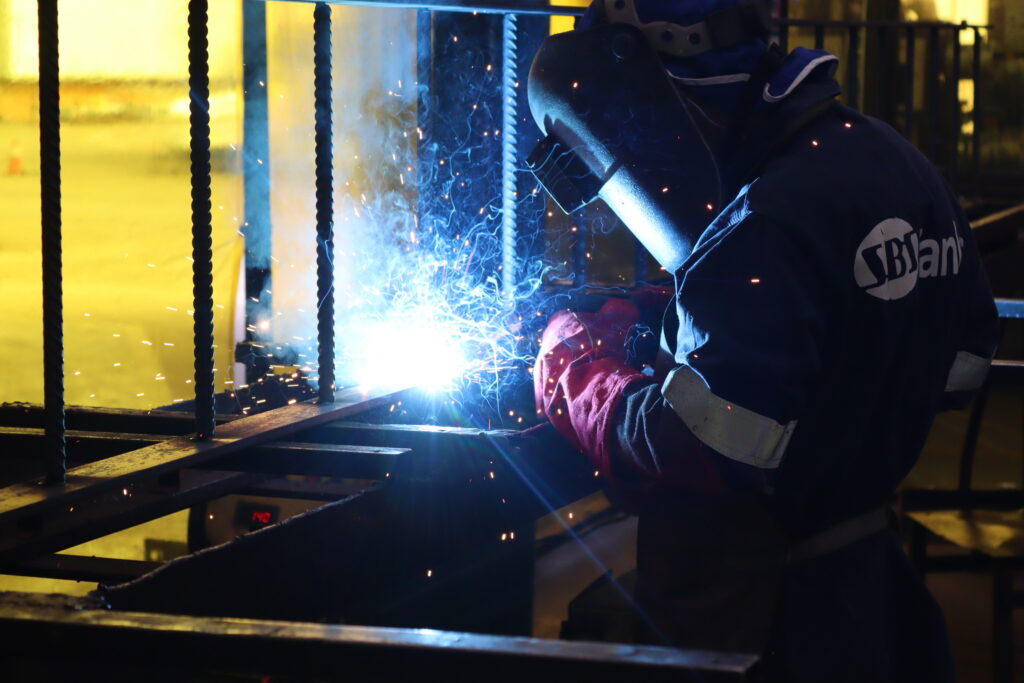
Move into Fabrication and the scene changes again. Here, specified steel sections become roof trusses and other structural assemblies. Elsewhere within the fabrication work, functional components are made for the points where water enters or exits the tank, or where people need access for inspection and maintenance.
A roof truss and an inlet nozzle may look unrelated, yet both begin with the same idea: a particular engineering requirement must be made real. The skill lies not simply in cutting or welding, but in producing the final components to the highest levels of quality to ensure they function as designed.
The departments do not work in series one after another, instead they operate in parallel. Their outputs eventually converge in Pre Dispatch, with items from Stores, where manufactured and supplied parts are brought together for the order. Panels, the protected liner, fabricated fittings, fasteners and other specified items must be identifiable and accounted for according to the Quality Management System (ISO 9001:2015).
This is where you begin to appreciate modular manufacturing. The factory has not produced a single enormous object. It has produced a co-ordinated collection of components that will become that final product at the installation site.
For the customer, that means there is an organised manufacturing process behind the tank they are purchasing, with systems designed to support accuracy, accountability and confidence in the components supplied.
For engineers and project teams comparing steel water tank manufacturers, the important questions go beyond machinery and production capacity. How are engineering requirements translated into manufacturing? How are components checked, identified and prepared for installation? And what gives customers confidence that their tank is being manufactured to the stringent international specification they require?
At SBS Tanks, that confidence comes from an established, ISO-certified manufacturing environment, supported by highly skilled people, documented processes and digital production management. ISO 9001:2015 provides the framework for consistent quality management and continual improvement, while ISO 45001:2018 supports systematic workplace health and safety practices. Together with Autodesk Fusion Operations, these systems support co-ordinated, repeatable, traceable and auditable manufacturing.
Because a water tank is more than a collection of steel panels, liners and fittings. It is an investment in infrastructure where manufacturing accuracy, quality and accountability are non-negotiable.
An established manufacturing facility with documented procedures, defined quality checks and production traceability gives customers confidence in both the product and the people responsible for making it.
Understanding the engineering expertise, manufacturing capability and quality systems behind a tank makes all the difference when specifying and selecting an SBS Tank.
The core tank components are manufactured at the SBS facility in Pinetown, Durban, South Africa.
No. SBS manufactures and prepares modular components that are subsequently assembled at the project site.
Rolling, Liner Manufacturing, Fabrication, Stores and Boxing & Kitting work from the order’s specifications.
Project planning, documented production information and digital shop-floor systems help teams coordinate manufacturing activities and checks.
© SBS Holdings 2026