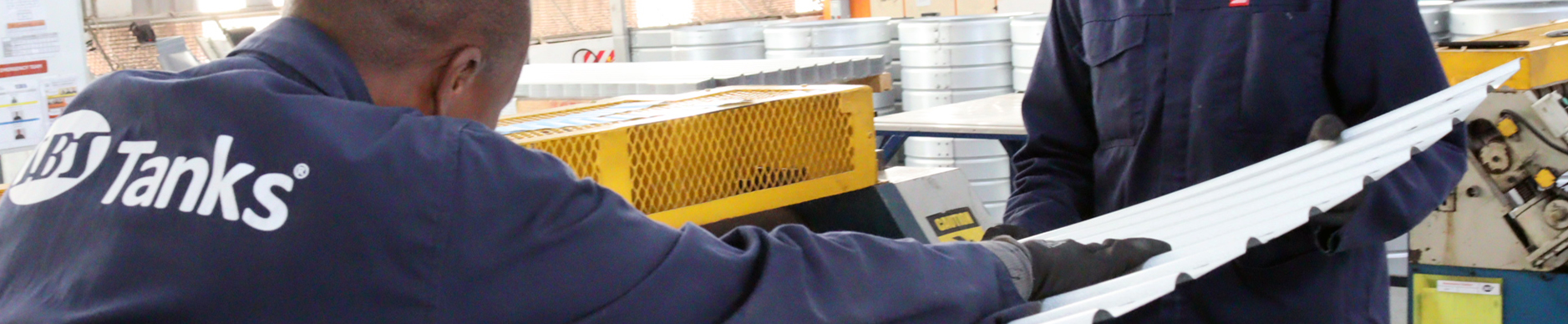

SBS steel water tank walls are made from engineered Galvalume steel panels rolled to the required tank radius. Water pressure increases with depth, so panel thickness and reinforcement vary by design. Manufacturing checks help each panel match its intended ring and the completed tank structure.
Start with a flat piece of sheet metal. Now imagine it becoming one small but crucial element of a circular tank capable of holding hundreds of thousands – or millions – of litres of water. The finished curve looks effortless, but it is the result of detailed engineering and precision manufacturing.
At SBS Tanks’ factory, the Rolling department transforms flat sheet metal into profiled and curved wall panels for our steel water tanks. Watching the transformation is fascinating; understanding why each panel has its particular shape, thickness and purpose is even more revealing.
A tank wall isn’t simply a circular structure made from interchangeable pieces. Each panel must meet the particular diameter of the tank it will form, but the geometry also determines how the structure retains the water inside it.
Water pushes against a tank wall, creating hydrostatic pressure that increases with depth. In a cylindrical tank, the wall resists much of this outward force through circumferential forces known as hoop tension. The circular form makes efficient use of steel by distributing these forces around the shell, rather than relying on flat walls and corners to resist them through bending and additional support.
The hydrostatic pressure is greatest towards the bottom of the tank. That is why an engineered wall can use different panel thicknesses and laminated reinforcement in different zones of the tank. The design considers not just how the panels fit together, but what each ring of panels must withstand.
SBS’s structural design assessments for applicable tank ranges reference SANS 10160 and SANS 10162. Behind a seemingly simple curve is a carefully designed and calculated structural system.
Steel arrives in batches and is checked for quality and compliance against the relevant QC requirements, including the specified material and thickness. Prepared panels then pass through rolling plate equipment to achieve the required radius, which trained operators verify against the tank’s configuration using model specific verification gauges.
That check matters. The machine mechanically bends the steel, but the operator must confirm that the result is right for the job. A panels final curvature is critical to its final usage, tolerances are tight and accuracy is non negotiable.
Different models and rings can also require different steel gauges. Where the engineering specifies lamination, layers of steel are combined to provide the necessary reinforcement. Rolling therefore involves more than producing identical panels all day: operators manufacture defined components for defined positions in a larger structure.
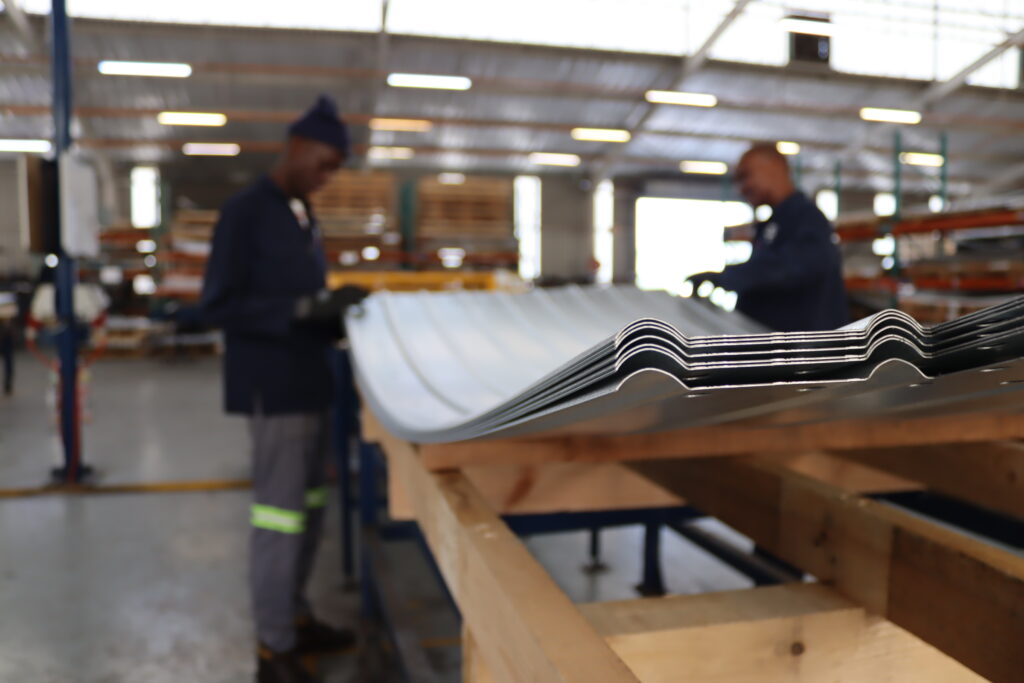
The steel itself is just as important as its shape. SBS tank walls use G300 Galvalume® steel. G300 denotes a minimum guaranteed yield strength of 300 MPa, a material property engineers use when designing the tank structure.
Galvalume is a cold-rolled carbon sheet metal coated with a hot dipped alloy of 55% aluminium, 43.4% Zinc, and 1.6% Silicon. SBS specifies AZ150, a coating class representing a nominal 150 g/m² across both sides of the sheet. This helps protect the steel against atmospheric corrosion and assures longevity of the finished product which is specified in accordance with SANS 9364.
The wall also works alongside an internal liner. The steel provides structural support while the liner contains the stored liquid, preventing direct contact between the water and the steel wall. Together, the selected steel, protective coating and separate liner ensure durability and reduce the potential of corrosion.
Simple and routine exterior wash-down helps remove dirt and deposits, while additional surface coatings can be specified for more demanding operational environments. Durability is not one feature; it is the result of material selection, design and appropriate care.
The rolling department produces an array of wall panels including some specially prepared for access, large connections or installation site/project specific requirements.
A Side Wall Access Hatch (SWAH)/manhole creates a designated opening for personnel access, inspection and maintenance, requiring a purpose-made curved panel and hatch assembly.
Larger nozzles create an engineering challenge which is often overcome by the SBS team. Attaching a rigid nozzle to a curved panel introduces local stiffness and connection forces that can distort the surrounding steel. Therefore, heavier, specially prepared panels help preserve the intended curvature and accommodate the additional loads.
Installer escape-hatch panels allow installers to access the space between the liner and tank wall, including to secure liner tags to the structure. These attachments help control liner movement and reduce tearing risk when water flow causes agitation, while the hatch allows safe movement in and out during installation.
Each variation shows how a single tank wall can incorporate engineering, operating and installation requirements – not simply repeat the same panel hundreds of times.
Once formed and checked, panels are identified for their tank model and ring position. Rolling and palletising records help organise the required quantities, gauges and laminated configurations before components move towards Boxing & Kitting. Panels are packed in the order they will be used on site.
Imagine the installation team opening the shipment on site. They weren’t beside the rolling machine, but they need to know which panels belong where. Panel identification protocol and assembly order preparation connect the work completed in the factory with the structure assembled on site
A completed tank wall may look simple, but every part of it has an important reason for being there: the specified material grade that helps resist water pressure, the reinforcement in the lower rings, the correct coating, and the specialist panels that allow the tank to function and be installed as designed/engineered.
Every panel has a defined purpose, and every manufacturing step contributes to the integrity of the finished SBS liquid storage structure.
It matters because structural performance and long-term durability begin long before installation – with sound engineering decisions, carefully specified materials and the accuracy of product specific manufacture.
The circular wall carries water pressure primarily through circumferential hoop forces, allowing an efficient cylindrical structure.
Not necessarily. The approved design may specify different steel gauges or reinforcement for different tank heights and loads.
Galvalume uses an aluminium-zinc protective coating; AZ150 designates the specified coating class.
Yes. Applicable tank designs can use specially prepared panels for access or large connections.
© SBS Holdings 2026