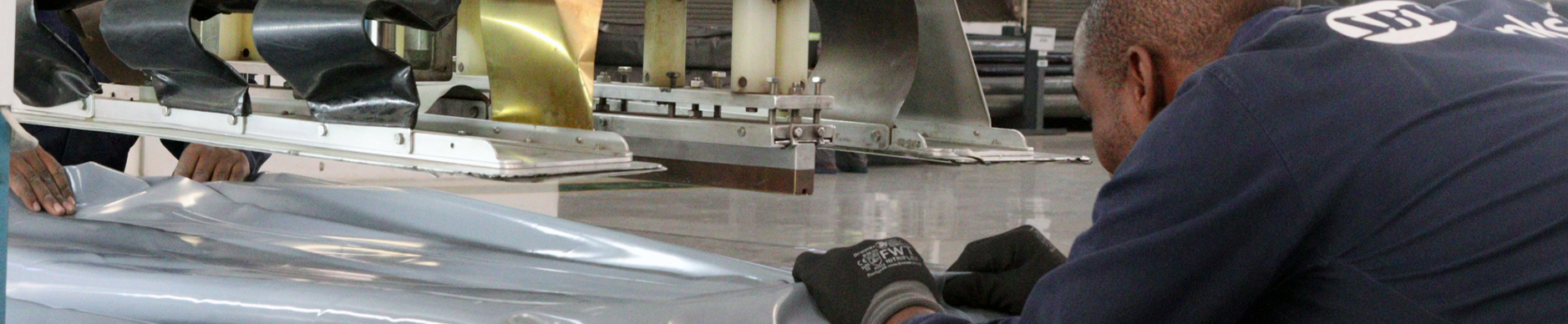

SBS manufactures flexible liners at its Durban facility for specified lined steel storage tanks. The liner forms the liquid-contact barrier while the steel shell carries structural loads. Materials and documented approvals must suit the actual liquid; representative incoming-batch checks support controlled manufacture.
When most people picture a steel water tank, they see the curved walls, roof and connections. Yet the component that actually meets the stored liquid is largely invisible: a flexible liner inside the steel structure. The distinction matters. Steel provides structural strength; the liner provides liquid containment.
Walk into SBS Tanks’ Liner department and the contrast with Rolling is immediate. Here, rolls of specialist liner material are measured, cut and welded into a containment component shaped for a particular tank. It is a different kind of manufacturing, but one equally important to the finished product.
Similar tanks of the same size can have very different jobs. One might store drinking water for a community, another process water for a food and beverage plant, and another wastewater or liquid associated with seawater reverse osmosis (SWRO). Liner selection depends on the liquid, the intended duty and the operating conditions.
SBS offers reinforced PVC international liner materials in 720 g/m² and 1,000 g/m² options, which are approved to recognised drinking-water contact standards such as AS/NZS 4020 and NSF/ANSI 61, in line with applicable WHO drinking-water quality guidelines. Such approvals are important to municipalities and food and beverage manufacturers, where the continuous quality ofstored water forms part of essential infrastructure.
For wastewater, industrial effluent and certain SWRO-related duties, SBS can also specify specialist chemical-resistant liners where suitable. The advantage is choice: the material can be selected for the duty of the stored liquid, while the steel shell continues to perform its designed structural function.
The manufacturing team utilizes the specified tank diameter and wall height. Large sections of liner material are measured, prepared and joined using the established high frequency or hot air welding process. Each seam contributes to a continuous containment surface that must fit the steel structure in which it will be installed.
SBS welds attachment tags onto the liner during manufacture. During installation, these tags secure the liner to the tank structure at regular intervals, helping control movement where forceful inflows, aeration or agitation could otherwise place additional strain on the liner. That is particularly relevant to selected wastewater treatment and industrial process applications.
What looks like a small manufacturing detail can therefore play an important role long after the tank is commissioned.
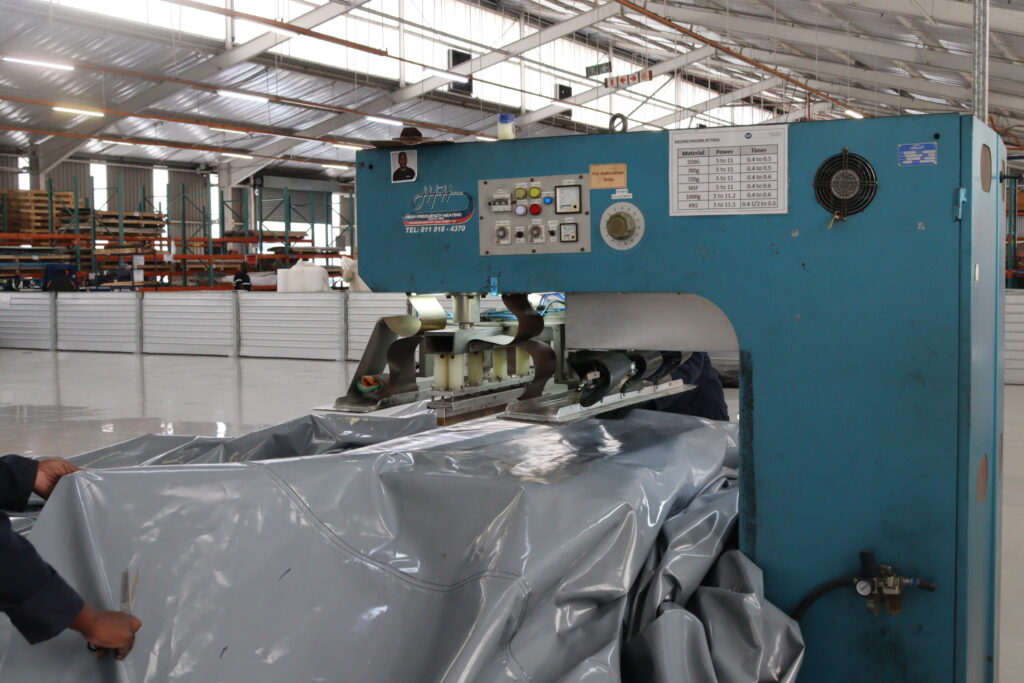
Because the liner is the liquid-contact surface, SBS handles it with extreme care in a protected working environment cut sections are positioned, HF welded, strategically folded, and prepared for final project packing. Where specified, protective geotextile such as Bidim is also prepared for the tank-base interface.
Every incoming batch of liner material undergoes quality-control testing according to ISO Q.M.S, including applicable sample welding and water-pressure checks, before it is accepted for manufacture. Only batches that meet SBS’s requirements are released into the production process.
This is perhaps the most important principle behind the SBS lined-tank design. The engineered Galvalume steel shell carries the structural loads, while the liner contains the liquid. By keeping stored water or other compatible liquids from normally contacting the structural steel, this arrangement reduces exposure to internal liquid-related corrosion.
It also provides flexibility over the life of the asset. Liners get periodic inspections to ensure integrity. For infrastructure owners, that separation of containment and structure makes a meaningful difference to long-term maintenance costs and ensures asset value.
The modular tank design offers another advantage: future capacity. SBS’s approved model range already defines the panels and laminates required for different tank heights. Where an existing tank can be extended to a taller approved configuration, additional panels can be fitted and a new liner manufactured for the increased capacity, thus retaining the same footprint, while increasing stored capacity.
Once complete, the liner is carefully rolled, with trapped air released to reduce packing volume, then identified and protected for transport. It will eventually meet the curved wall panels, fabricated fittings and other components prepared elsewhere in the factory.
The finished tank may look like a steel structure, but the liner is what makes it a versatile liquid-storage asset. The right material, accurate manufacture and thoughtful attachment details help protect the stored liquid – and the structural investment surrounding it.
The liner contains the liquid separately from the steel shell, reducing direct water contact with structural steel.
Specific SBS liner materials have potable-water contact documentation under applicable standards; confirm the exact material approval for the project.
No. Material, thickness and compatibility are selected according to the stored liquid and required duty.
Where condition and tank configuration allow, a liner can be inspected or replaced without automatically replacing the structural shell.
© SBS Holdings 2026