
When engineers think about corrosion on a desalination project, the first question is often straightforward:
“How close is the plant to the ocean?”
It’s an important question – but it is rarely the only one.
As discussed in our Engineering Month article, Corrosion Engineering for Water Storage Infrastructure, successful corrosion engineering requires engineers to assess far more than the project’s geographical location. Environmental classification, stored-water chemistry, process duty, vulnerable components and the client’s required service life all influence the protection systems ultimately specified. Corrosion engineering is therefore not a single product or coating selection – it is a layered engineering philosophy applied throughout the design process.
Two recent desalination projects delivered by SBS Tanks demonstrate this perfectly.
Yet each demanded a completely different corrosion protection strategy.
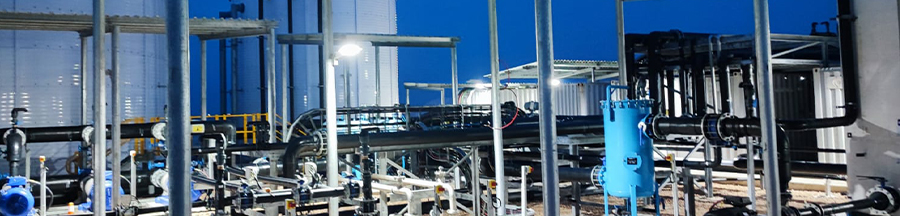
One of Africa’s largest LNG developments required a reliable water supply for approximately 9,500 personnel working at the remote Afungi site in northern Mozambique.
A new seawater reverse osmosis plant formed part of the infrastructure, with SBS Tanks supplying five cyclonic storage tanks that supported every stage of the treatment process – from seawater intake (1.24M) through to backwash (196kl), outfall (324kl) and two treated product water tanks (3.3Ml each).
At first glance, the engineering challenge appeared straightforward.
In reality, the site presented one of the harshest operating environments possible for steel infrastructure.
Located close to the Indian Ocean, the tanks will likely be continually exposed to salt-laden air, high humidity, cyclic wetting and seasonal cyclonic weather. These conditions correspond to a severe C5 atmospheric corrosion environment, where chloride contamination significantly accelerates corrosion if appropriate protection systems are not incorporated during design.
As highlighted in our Engineering Month article, environmental classification forms one of the first steps in determining corrosion protection requirements. The objective is not simply to select the highest level of protection available, but rather to specify a system appropriate for the operating environment and the client’s expected asset life.
For Subtech, the corrosion assessment led to the selection of a factory-applied thermoset powder coating over the external Galvalume® steel panels. The coating is electrostatically applied as a dry powder before being heat cured, producing a continuous polymer barrier that isolates the steel substrate from the surrounding environment. This additional barrier helps minimise the ingress of moisture, oxygen and airborne chlorides – three of the principal drivers of atmospheric corrosion in coastal environments.
As discussed in our Engineering Month article, coating systems should be selected according to environmental classification and required asset life rather than simply initial project cost. On the Subtech project, powder coating was therefore specified as part of a layered corrosion protection strategy. Working alongside the inherent corrosion resistance of the Galvalume® substrate, it enhanced the durability of the external tank structure within the aggressive C5 marine environment while helping reduce future maintenance over the life of the asset.
However, the engineering assessment did not stop there.
Although all five tanks formed part of the same desalination plant, they did not all store the same liquid. The seawater intake tank continuously stored untreated seawater, while the product-water tanks stored treated potable water. Each tank therefore experienced different internal operating conditions, influencing liner selection and the protection systems specified for critical components.
Corrosion rarely develops uniformly across an entire structure. Instead, it commonly begins around interfaces and discontinuities such as nozzles, penetrations, ladders and attachment points where protective coatings are interrupted or exposure becomes concentrated.
This principle directly influenced the Subtech design.
Components continually exposed to untreated seawater – including inlet and outlet nozzles, floor-mounted pipework and internal ladders – received plascoated protection, while selected wetted components incorporated glass-flake epoxy systems to provide additional resistance where required.
Rather than relying on one protective system, the project adopted multiple complementary layers of corrosion protection tailored to the operating conditions of each component.
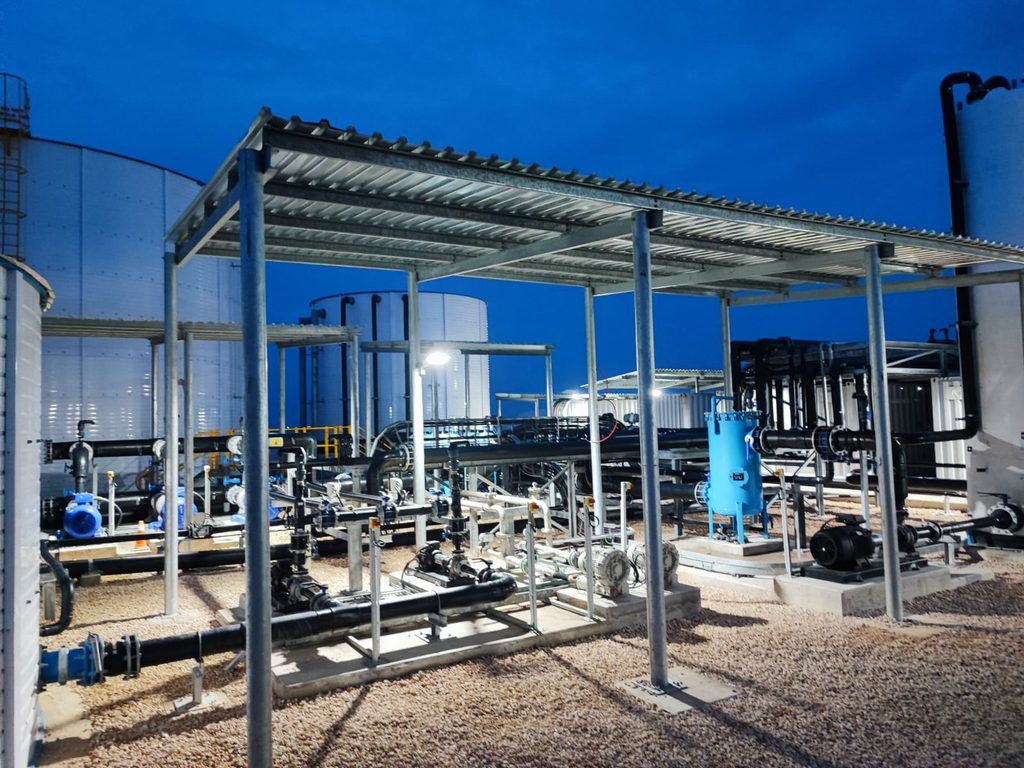
The Odis Filtering project in Limassol, Cyprus, presented a very different engineering challenge.
The project involved refurbishing and recommissioning an existing government desalination plant to restore potable water supply to surrounding communities.
Like the Subtech project, seawater formed the basis of the treatment process. Unlike Subtech, however, the plant itself was located sufficiently inland that it was not classified as a severe C5 atmospheric corrosion environment. The external steel structure therefore did not require powder coating.
Instead, the engineering challenge shifted from protecting the outside of the tank to protecting the components continually exposed to seawater and process liquids inside it.
SBS supplied three storage tanks comprising raw water (516kl), backwash (55kl) and a treated product water storage (516kl).
Before finalising the engineering design, Odis Filtering supplied detailed water quality information – including pH and treatment parameters – which SBS engineers reviewed to determine the most appropriate liner specification for each individual tank.
As discussed in our Engineering Month article, corrosion rarely develops uniformly across an entire structure. Instead, it typically begins at interfaces such as nozzles, penetrations, flanges and access components where exposure is concentrated and protective systems are interrupted.
Critical wetted components – including inlet and outlet nozzles, roof penetrations, overflows, dump drains and internal access ladders – were therefore specified with Plascoat protection as part of the corrosion management strategy.
Plascoating is a specialist thermoplastic polymer coating applied to fabricated steel components using a controlled heat-fusion process. Once bonded to the steel surface, it forms a continuous, non-porous barrier that isolates the underlying steel from water, dissolved salts and oxygen – the primary causes of corrosion in immersed environments. Unlike conventional paint systems, the coating provides excellent chemical resistance, impact durability and long-term performance under continuous water immersion.
The Plascoat system specified for this project is also suitable for potable-water contact, allowing SBS to protect critical components against corrosion while maintaining compliance with water-quality requirements. By engineering additional protection into the areas most exposed to seawater and treated process water, the design reduced the risk of localised corrosion and contributed to the long-term reliability of the overall storage system.
Close collaboration between SBS Tanks and Odis Filtering also extended beyond corrosion protection. General Arrangement drawings progressed through multiple revisions while the engineering teams refined European flange arrangements, nozzle locations, roof-mounted permeate inlets, internal pipe supports and diffuser configurations to integrate seamlessly with the wider desalination process.
The result was a storage system engineered around the treatment plant – not simply supplied to it.
Viewed side by side, the Subtech and Odis Filtering projects demonstrate that corrosion engineering is driven by understanding where the risk originates.
For Subtech, the primary threat came from the aggressive marine atmosphere surrounding the tanks.
For Odis Filtering, the greater challenge lay within the seawater and process liquids moving through the treatment plant.
The engineering response therefore differed accordingly.
Subtech required enhanced protection of the complete external structure through powder coating, supported by plascoated and specialist protected wetted components.
Odis Filtering relied on standard Galvalume® protection externally while focusing additional engineering attention on the internal nozzles, penetrations, ladders and process interfaces exposed to seawater.
Neither approach was inherently better than the other.
Both represented the correct engineering response to the conditions each project presented.
The most successful water storage infrastructure is rarely the result of a single engineering decision.
Instead, it reflects hundreds of technical choices made throughout the design process – from environmental classification and structural loading through to water chemistry, liner compatibility, coating systems and component selection.
The Subtech and Odis Filtering projects demonstrate why engineers should resist standardising corrosion protection across every desalination project.
Instead, they should ask five fundamental questions:
Answering these questions allows engineers to specify protection systems that are appropriate for the application rather than simply selecting the highest specification available.
That is the essence of corrosion engineering – and ultimately what delivers durable, reliable water infrastructure capable of supporting critical communities and industries for decades.
Every desalination project presents different engineering challenges. Whether you are designing an SWRO facility, municipal treatment works or industrial process plant, involving SBS Tanks during the early design stages allows our engineers to assess environmental exposure, water chemistry, structural requirements and corrosion protection strategies to support long-term asset performance.
Speak to one of our consultants today to discuss the operating conditions, storage requirements and engineering considerations for your project.
SBS Tanks® is Africa’s leading manufacturer and supplier of modular steel panel water storage tanks fitted with internal liquid storage liners. With offices in Durban, Johannesburg and Cape Town, our factory services all provinces within South Africa and the SADC region.
_______________________________________________________________________________________
Not every desalination project requires the same corrosion protection strategy. While both the Subtech project in Mozambique and the Odis Filtering project in Cyprus stored seawater, their engineering requirements were fundamentally different. One required enhanced protection of the entire external structure within a severe C5 marine environment, while the other focused on protecting critical internal components exposed to seawater and treatment processes. Together, these projects demonstrate why successful corrosion engineering begins with understanding the source of the corrosion risk—not applying a standard specification.
Why did the Subtech project require powder coating?
The tanks operated in a severe C5 marine environment with continual exposure to salt-laden air, high humidity and cyclonic conditions. Powder coating formed part of the lifecycle engineering strategy to protect the external steel structure.
Why wasn’t powder coating required for Odis Filtering?
Although the plant processed seawater, it was located sufficiently inland that the atmospheric environment did not justify enhanced external coating. The primary corrosion risk came from the liquids inside the tanks rather than the surrounding atmosphere.
Why were plascoated components used on both projects?
Critical wetted components such as nozzles, penetrations and internal ladders remain exposed to aggressive liquids and are often the first areas where corrosion develops. Plascoating provides additional protection for these vulnerable interfaces.
What is the main engineering lesson from these projects?
Corrosion protection should be selected according to the actual operating environment, stored liquid, component exposure and required service life—not applied as a standard specification across every project.
© SBS Holdings 2026