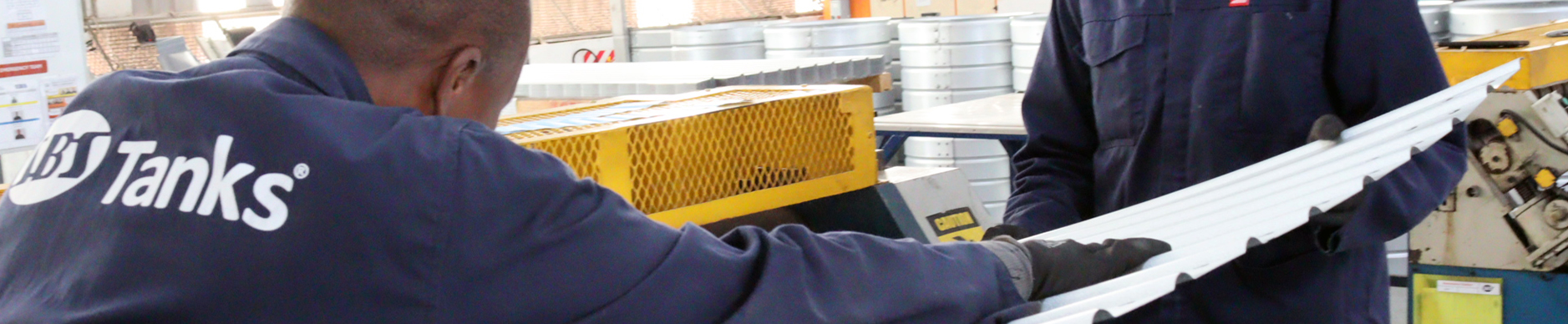

A modular steel water tank is assembled from individual wall panels. Before installers can build successive rings on site, those panels need the geometry, material specification and identification appropriate to the tank being supplied. This work begins in the SBS Rolling department at the Pinetown factory.
The important manufacturing question is not simply whether a machine can bend steel. It is how the department produces panels suitable for the intended tank configuration, checks the finished curvature and prepares them for an order containing many other components.
Steel arrives as flat material before it is processed into curved wall sections. The required curvature depends on the tank model and its diameter. Operators select and process the designated material in line with the relevant production information, then use the department’s curvature-checking equipment to verify the result.
This is a useful distinction for specifiers: not every steel water tank uses identical panel geometry or thickness. A factory can follow an established rolling process while varying specified panel dimensions and material characteristics to suit the engineered tank range.
Some tank configurations require additional panel reinforcement through lamination. This does not mean every panel is laminated or that every tank has the same reinforcement requirements. The applicable panel arrangement comes from the production information for the relevant configuration.
Manufacturing therefore combines repetition with specification discipline: the department performs familiar operations while working to the particular product’s needs.
The Rolling department can also process specified specialist tank-wall features, including particular access or escape hatch arrangements and panels accommodating larger connections where required. These examples illustrate coordination with project requirements; they should not imply that every order is a one-off tank designed without reference to an established product range.
Any public example of a special feature should be accompanied by approved imagery and a technically confirmed description of its purpose.
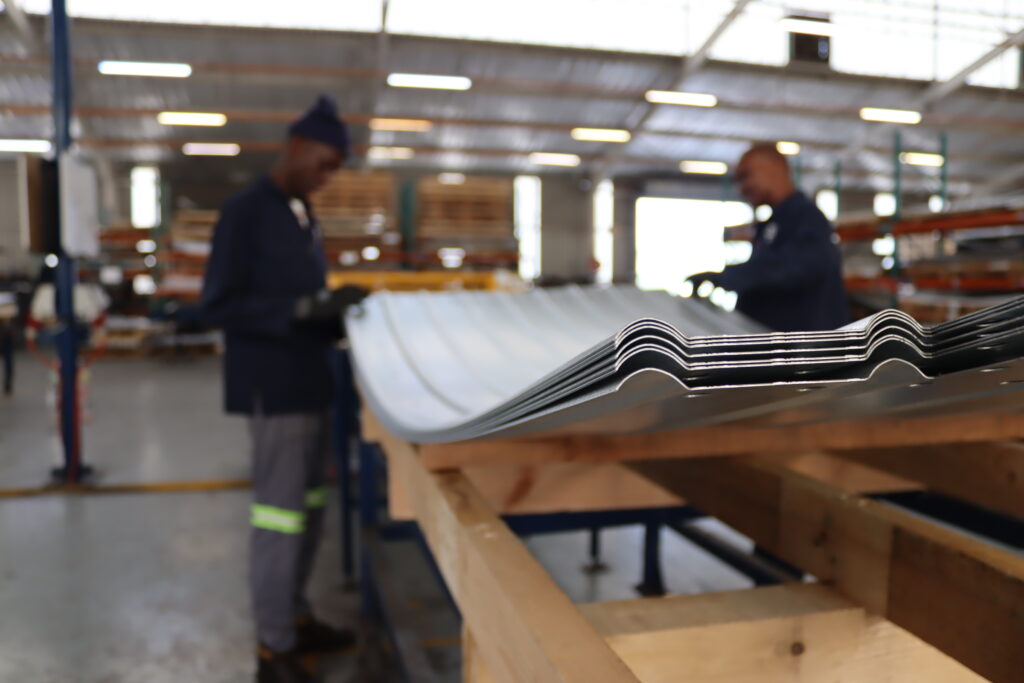
Manufacturing does not end when a panel has the intended curvature. The panels must be identified according to the tank and ring arrangement, collected and palletised so that Boxing & Kitting can include them in the correct order.
An individual panel may look unremarkable in isolation. Its value emerges when it is part of a set whose geometry, quantity and identification are suitable for the final tank. A mistake in this stage may be discovered much later, when the installation team expects parts to fit together.
SBS Rolling demonstrates a key benefit of factory-based modular manufacture: established production methods linked to defined product configurations. It is not a claim that every tank is identical. The panels need to reflect model-specific requirements, while the process must be repeatable enough to support coordinated assembly.
For engineers reviewing steel water tanks, the practical questions are straightforward: what tank geometry is being manufactured, how is the curved profile checked, and how are completed panels identified for installation? These considerations connect an apparently simple factory operation to the eventual assembled structure.
The journey from flat steel to a tank wall is a sequence of specified material selection, controlled shaping, verification and preparation for kitting. Rolling is only one department, but its output establishes the steel shell components on which later installation depends.
To discuss panel configurations or the appropriate SBS tank range for a proposed storage duty, contact an SBS Engineer.
It is the factory process of shaping flat steel into curved wall panels used to assemble the cylindrical tank shell.
No. The required curvature depends on the tank model and its geometry.
No. Lamination is used where the applicable panel reinforcement requirements call for it.
Panels are identified by the applicable tank/ring arrangement and prepared for order consolidation and installation.
No. Tank suitability also depends on engineering, material specification, liner selection, structural elements and site requirements.
© SBS Holdings 2026