
Every industrial, commercial or municipal water storage project eventually faces more than a material choice. The project team must compare capacity, programme, site access, construction method, liquid compatibility, maintenance, future expansion and total delivery risk. Steel, concrete and polyethylene can all play a role, but they solve different project problems.
Polyethylene tanks are practical for smaller, low-bulk residential use. Concrete reservoirs remain familiar on some civil infrastructure projects. Modular steel tanks are well suited to engineered bulk water storage where speed, scalability, serviceability and long-term asset value matter. This article is written for engineered project applications, not domestic retail tank buyers.
A fair comparison should assess the full project journey, not only the finished tank or reservoir. Project teams should consider design, manufacture or construction, delivery, installation, inspection, commissioning, maintenance and future changes.
A small facility needing temporary backup water will not make the same decision as a mine, water board, industrial plant or logistics park requiring hundreds of thousands or millions of litres. The application, duty, volume, water quality, foundation, access and programme risk should be confirmed first.
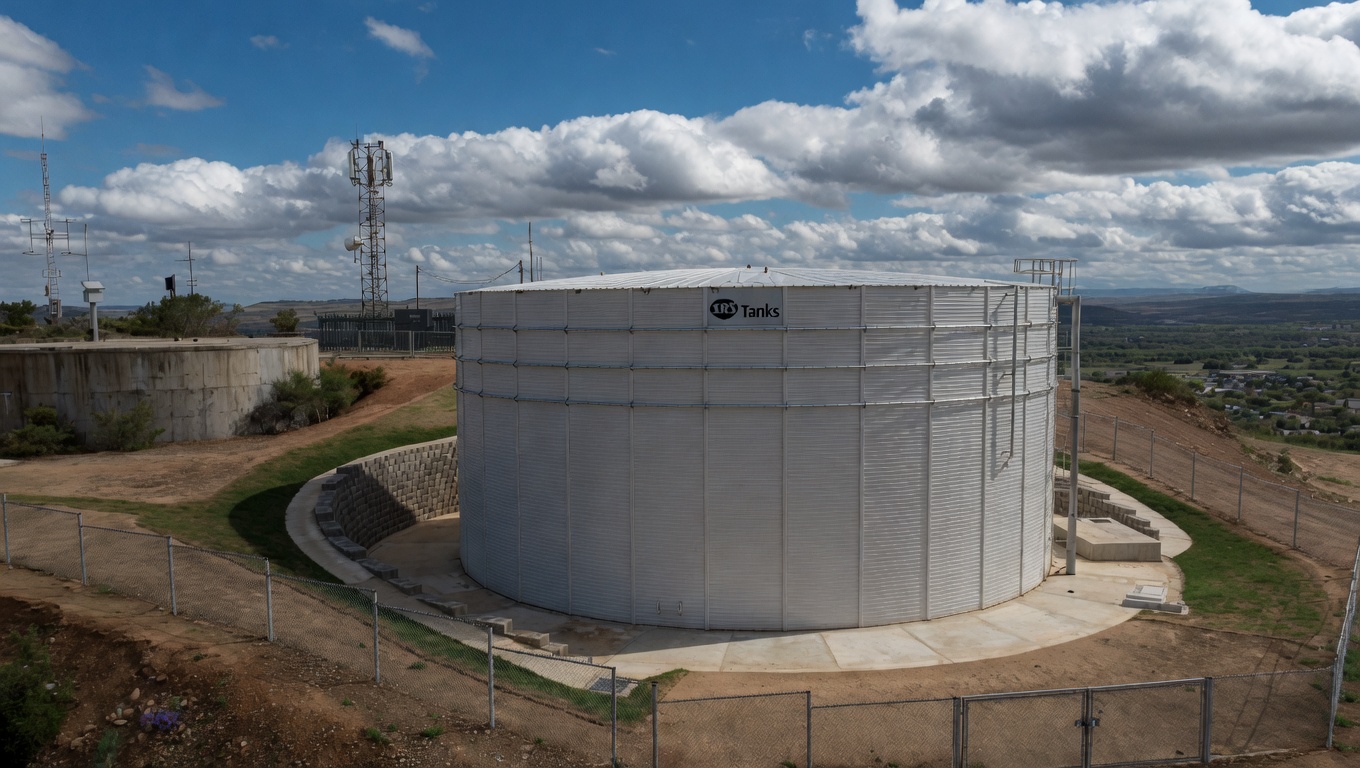
For larger engineered projects, modular steel tanks are often selected because components can be manufactured off site while the foundation or ring beam is prepared. Concrete may suit buried or cast-in-place structures. Polyethylene tanks are useful at smaller scale, but linked units become harder to manage as capacity and pipework complexity increase.
A fair comparison should look at the full project journey, not only the finished tank. Project teams should consider how each option is designed, manufactured or constructed, delivered to site, installed, inspected, commissioned, maintained and adapted over time. This is especially important where storage is needed for public infrastructure, industrial operations, fire protection, mining, logistics parks or commercial developments.
| Criterion | Modular steel tanks | Concrete reservoirs | Polyethylene tank farms |
|---|---|---|---|
| Best fit | Time-sensitive, remote, constrained, phased or adaptable bulk storage. | Permanent in-situ or buried infrastructure. | Smaller or low-bulk applications. |
| Construction control | Factory-made components with repeatable quality checks. | Quality depends on site workmanship, materials, curing and supervision. | Factory-made units, but with limited large-volume flexibility. |
| Programme timeline | Manufacture can progress while site works are prepared, reducing project timelines. | Sequential excavation, reinforcing, formwork, curing and testing. | Fast for small units; more complex when many units are linked. |
| Site logistics | Packed and inventoried modular components. | Ongoing material, plant, reinforcement, formwork and concrete deliveries. | Larger farms require more bases, valves, pipework and space. |
| Liquid containment | An internal liner separates the liquid from the steel. No structural components are submerged in the stored water. | Sealing performance depends on the concrete, joints, finishes and waterproofing quality. | Limited by polymer and fittings compatibility. |
| Serviceability | Above-ground access supports inspection and maintenance planning. | A long service life is possible, but repairs can be more involved. | Simple for small units; ageing, sun damage and additional pipework can increase the maintenance burden. |
| Future adaptability | Additional tanks or modifications may be assessed. Expansion on the same footprint may also be possible through a taller tank configuration using the same base. | Changes can require invasive civil work or demolition. | Additional units increase the required footprint and pipework. |
| Long-term value | Strong where speed, quality control, access and serviceability matter. | Strong where site conditions, budget and programme allow. | Useful for smaller requirements, but generally less efficient at large scale. |
Modular steel tanks are well suited to projects that need meaningful bulk water storage without the extended, site-heavy programme often associated with in-situ concrete reservoirs. They are useful where programme certainty, site access, construction control, maintenance planning and total delivery risk matter.
The advantage is not only tank erection speed. With a modular steel tank, engineering, manufacture, quality checks and packing can progress while the foundation or ring beam is being prepared on site. This allows more of the project to run in parallel, reducing reliance on a long sequence of site-based activities such as reinforcement, formwork, concrete pours, curing and finishing.
SBS modular steel tanks use a panelised structure and internal liner system, allowing the tank to be matched to the application and stored liquid. Liners can be selected for potable water, process water, effluent, leachate, saltwater and other approved duties, subject to the final liquid profile and project specification.
Modular tank farms can also support operational flexibility where continuity of supply is important. When multiple tanks are designed to operate as an integrated storage system, individual tanks may be isolated for inspection, cleaning or maintenance while the remaining storage continues to support supply. This can reduce the risk of a complete shutdown compared with a single-storage structure.
SBS project references show how modular steel storage can support different project drivers across public-sector, commercial and industrial applications. The Pemba Community Water Supply Programme in Zanzibar is an example of modular steel being selected after reinforced concrete reservoirs were initially specified. Following technical evaluation, the client proceeded with four 1 ML ST26/04 modular steel tanks. The solution offered faster manufacturing and delivery, shorter installation timelines, corrosion protection through the internal liner system, reduced construction risk compared with cast in-situ concrete, and earlier commissioning of the water-supply network.
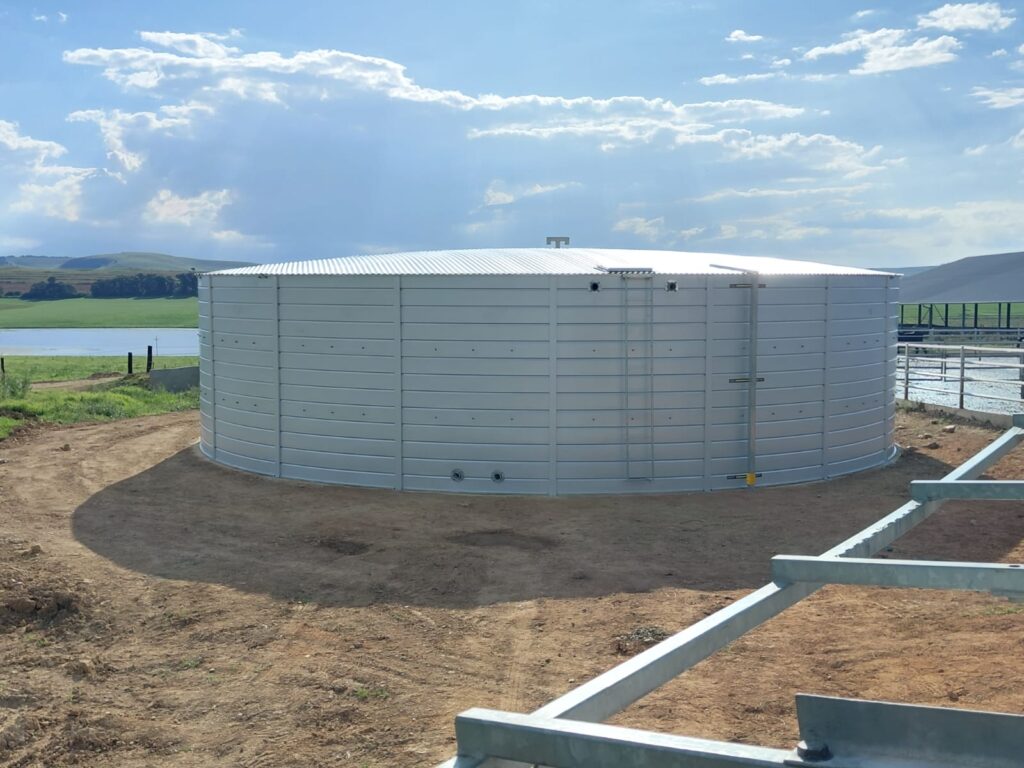
In South Africa, the Emalahleni potable water tank farm demonstrates multi-megalitre municipal storage at scale, with five ST31/09 tanks providing 16,505kL of storage. Commercial and industrial references add further context: Moffett Retail Park demonstrates a space-efficient, interconnected three-tank system for retail backup water under constrained site conditions, while Brookside Dairy in Kampala shows how modular steel storage can be installed in an operational food-processing facility using an existing slab, with installation completed in six days and minimal disruption to production.
Concrete remains proven for some reservoir projects, especially where the design requires a buried or cast-in-place structure, heavy civil integration or a clear preference for in-situ construction. A well-designed and well-constructed concrete reservoir can provide long service.
The decision should not be framed as steel versus concrete in isolation. It should compare the complete project delivery process, including programme, site access, construction control, logistics, supervision, maintenance access, adaptability and total project risk. Concrete may be the right choice where the site, programme, budget, supervision model and civil resources support that route.
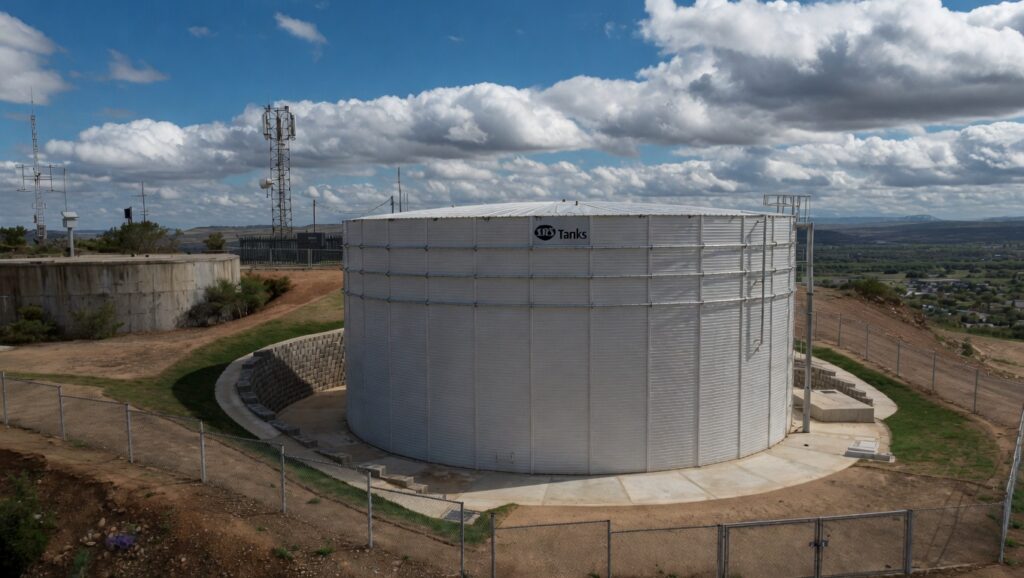
However, where extended curing periods, constrained access, cost certainty, programme pressure or reduced site disruption are major considerations, modular steel should be evaluated as a practical alternative. The Kirkwood municipal reservoir project is a useful example, where SBS supplied two large treated-water tanks for public water infrastructure and modular steel was selected for programme and cost efficiency. This type of comparison is strongest when the project team evaluates the full installed asset, not only the familiar construction method.
Polyethylene tanks are practical for smaller needs, temporary installations or low-bulk applications where quick delivery and low upfront cost are the main priorities. They are common in domestic, small commercial, agricultural and basic backup-water settings.
As demand increases, multiple plastic tanks can become less efficient. More units can mean more bases, connections, valves, pipework, fittings, cleaning points and maintenance areas. The project team should then compare the footprint, connection complexity, long-term serviceability and visual impact of a plastic tank farm against a modular steel alternative.
For smaller- to mid-capacity applications, the SBS Lite Tank Range provides a modular steel alternative where the required storage is larger or more permanent than a typical plastic-tank installation but does not require the scope of a large engineered tank project. With capacities from approximately 7 kL to 350 kL, the range is suited to applications such as farms, schools, small businesses, petrol stations, irrigation systems, rainwater harvesting and operational backup-water storage.
For larger or more technically demanding projects, the SBS Standard Tank Range is generally the stronger fit. The range provides modular steel storage capacities from 12 kL to 5.2 ML and can be configured for municipal, mining, commercial, agricultural, fire-protection and industrial applications. Its engineered steel structure, internal liner system and project-specific configuration options support projects where capacity, stored-liquid compatibility, quality documentation, installation planning and long-term asset performance are important considerations.
Before choosing between steel, concrete and polyethylene, project teams should confirm the full duty, not only the upfront tank or reservoir price. Useful questions include:
The best tank option fits the full project duty, operating risk and asset life, not only the lowest initial price.
Steel, concrete and polyethylene tanks each have a place in water storage planning. The best choice is not always the most familiar option, and it is not always the lowest upfront tank price. Project teams should compare the complete delivery process: design, manufacture or construction, access, programme, logistics, quality control, maintenance, future changes and long-term value. They should also consider how the storage system will operate after commissioning, including inspection access, isolation for maintenance, possible future expansion and continuity of supply.
For engineered commercial, industrial, municipal, mining and fire-water projects where speed, access, controlled manufacture, liner selection and serviceability matter, SBS modular steel tanks provide a practical alternative to traditional in-situ construction.
Contact SBS Tanks to discuss your project requirements and confirm the most suitable tank range, liner system and installation approach. Contact one of our sales agents today or request a quote here.
The best option depends on the project duty. Polyethylene tanks suit smaller uses. Concrete can suit permanent in-situ or buried reservoir projects. Modular steel tanks are often well suited where engineered bulk storage needs faster delivery, controlled manufacture, practical logistics, serviceability and future adaptability.
Yes. Modular steel tanks can be used for large commercial, industrial, mining, municipal and fire-water projects. SBS references include Kirkwood, KwaGuqa, Ruwa and Emalahleni, demonstrating modular steel storage across public-sector and bulk water applications.
The Lite Tank Range is useful where a client needs more durability, capacity or structure than many plastic tank-farm arrangements, but does not require a large Standard Tank project. It can be considered for commercial, agricultural, backup-water and mid-capacity operational storage applications.
Yes, subject to specification. Liner selection must be matched to the stored liquid, whether potable water, process water, effluent, leachate, saltwater or another approved duty. The project team should provide the liquid profile during the enquiry or specification stage.
Long-term value depends on installation time, capacity, foundation requirements, site access, corrosion protection, liner suitability, inspection access, service life, future adaptability, operational continuity and total delivery risk.
*****************************************************************************************
SBS Tanks® is Africa’s leading manufacturer and supplier of modular steel panel water storage tanks fitted with internal liquid storage liners. With offices in Durban, Johannesburg and Cape Town, and ISO 9001 and ISO 45001 accreditation, SBS Tanks services clients across South Africa and the SADC region with engineered water storage tanks for municipal, mining, fire protection, commercial, industrial, agricultural and water conservation applications.
*****************************************************************************************
© SBS Holdings 2026