

SBS fabricates hydraulic and access components around approved tank and system requirements, including nozzles sized for flow rate, suitable flange patterns, balancing connections between tanks, vents and access features. The client-approved General Arrangement drawing governs the intended interfaces.
Look at an SBS steel water tank from a distance and you notice its size. Step closer and the engineering becomes more interesting: an inlet positioned for a particular pipeline, an outlet designed for a pump, a vent above the roof or a ladder leading to an inspection hatch. These features may appear small beside the tank itself, but they determine how the storage asset works.
In our Fabrication department, we turn all specific operating requirements into purpose-made components for industrial water storage tanks and other applications. A tank’s capacity tells you how much liquid it can hold. Its connections and accessories determine how effectively that stored capacity can be used.
Imagine installing a large tank only to discover that the outlet is too small for the required pump flow, or that its flange does not match the connecting pipework. The steel structure might be perfectly manufactured, but without the correct auxiliary items, the water system would not perform as intended.
That is why we establish nozzle sizes, elevations, orientations and exact flange requirements as part of the tank’s engineering and client-approved General Arrangement (GA) drawing. Nozzle diameters respond to the hydraulic design, including required flow rates. We can fabricate side-mounted, floor-mounted and roof-mounted connections, with different flange tables and bolt patterns to suit any pipework.
Inlets, outlets, overflows, scour drains and specialist components such as sumps, deflectors and anti-vortex fittings each serve a purpose. For fire-protection reserves, connections are manufactured to meet project requirements under NFPA 22 and applicable ASIB-recognised sprinkler-system rules, including pump-suction arrangements. It is not enough to store the required volume: the effective volume of water must be available when needed.
Consider a site with three storage tanks, but a requirement to operate them as one combined reserve. Appropriately designed balancing lines connect the tanks through additional nozzles and pipework, allowing water levels to equalise and the tanks to function hydraulically as a shared storage system.
This gives operators flexibility when managing multiple tanks. But balancing connections must be sized and arranged for the intended flows, isolation and operating conditions. A balancing line is not simply another pipe between tanks; it is part of the system’s hydraulic design and takes careful planning and design.
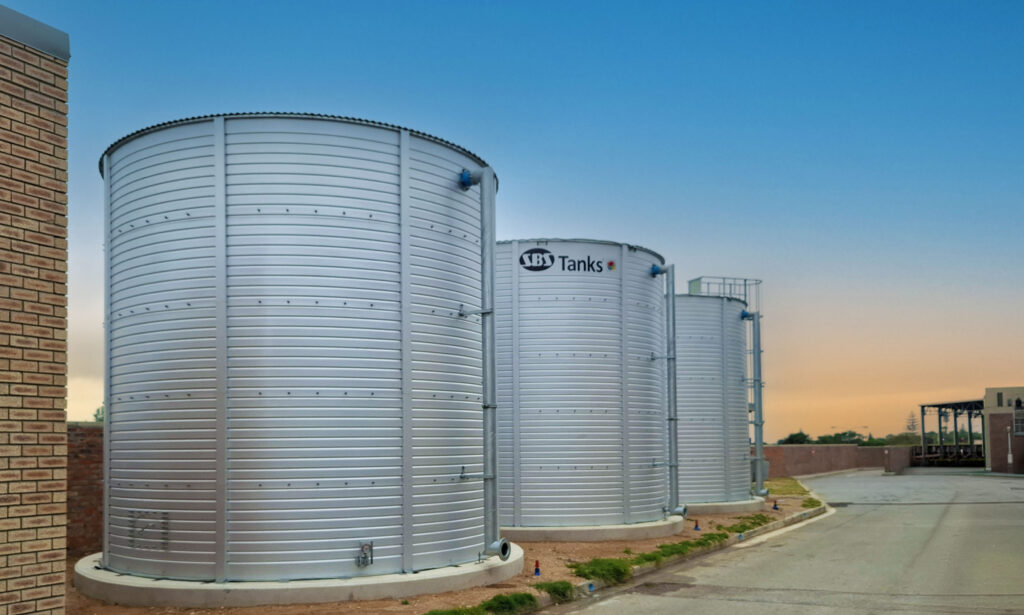
Our fabrication team works from a client-approved GA drawing, which records all the agreed nozzle positions, heights, orientations and connections. This matters because even a correctly manufactured nozzle can impact a project negatively if positioned in the incorrect place or at the wrong height.
While we manufacture the specified nozzle assemblies in the workshop, the final tank-wall penetrations are made on site during installation, aligned with the approved configuration. This connects factory precision with the actual assembled tank and its surrounding pipework.
Our standard mild-steel fittings are hot-dip galvanised after fabrication, in accordance with the applicable requirements of SANS 121 and ISO 1461. For more demanding duties, we offer additional protective coatings, including Plascoat systems, and material alternatives such as stainless steel and HDPE where appropriate.
Stainless-steel components are often required in selected food and beverage and industrial applications. In coastal, wastewater and desalination environments, corrosion resistance is equally important. Selecting suitable materials and coatings helps protect component integrity and supports the long-term value of the storage asset.
Storage tanks must be inspected, maintained and operated. Our fabrication capability therefore extends to access hatches, ladders, platforms, walkways and other unique components. Water-level indicators help operators monitor the available storage reserve without needing to physically inspect inside the tank.
Vents perform another essential function. SBS tanks are atmospheric storage tanks, not pressure vessels. As water enters, displaced air must escape; as water is withdrawn, replacement air must enter. Correctly specified venting helps prevent damaging pressure or vacuum conditions, particularly where pumps operate, emptying the tank at significant flow rates.
Behind each fabricated component are carefully selected materials, approved drawings, manufacturing job instructions and skilled, qualified welders, boiler makers and fabrication personnel.
Our ISO 9001:2015-certified manufacturing systems support material verification, defined welding procedures and component checks. Where specified, non-destructive testing, including dye-penetrant examination, can provide additional verification of weld integrity.
These disciplines matter because a poorly manufactured or incorrectly positioned connection can create installation delays, hydraulic restrictions and maintenance problems long after the tank leaves the factory.
A well-designed connection is not simply an accessory. It is where the storage tank joins the infrastructure it serves.
Our ability to manufacture different nozzle arrangements, flange configurations, balancing connections, corrosion-resistant components and access systems gives engineers greater flexibility to specify tanks around the requirements of their projects.
The next time you look at a tank, look beyond its walls. The smaller details will reveal just how thoughtfully the entire storage system has been designed by the SBS team.
Hydraulic requirements such as flow rate, pipework and service duty inform nozzle diameter and connection design.
Yes. Appropriately designed balancing lines and pipework can hydraulically connect tanks, subject to the intended flows and isolation arrangement.
Air must escape during filling and enter during drawdown to avoid excessive internal pressure or vacuum.
Suitable applications can specify stainless steel, HDPE or additional protective coatings subject to the project requirements.
© SBS Holdings 2026