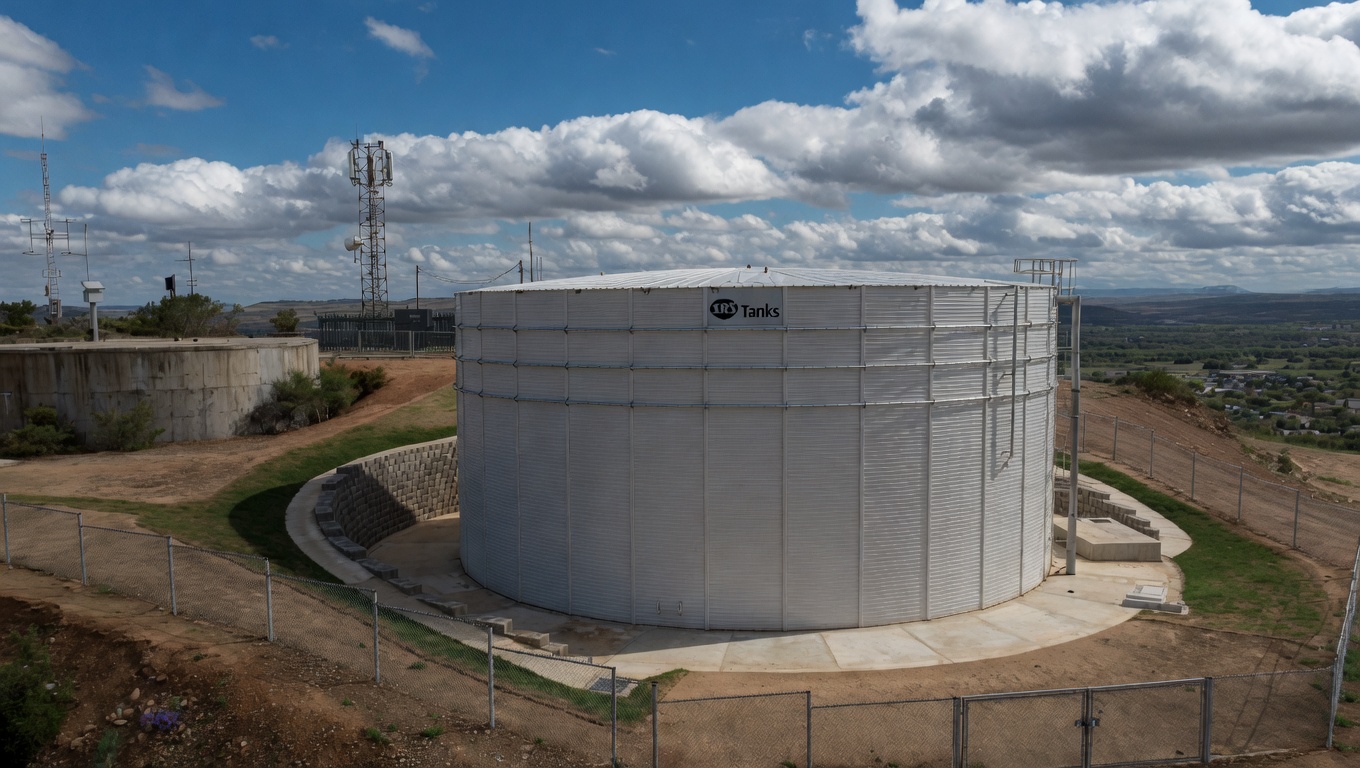

Design standards provide the foundation for safe structural engineering, but real-world conditions don’t always follow the textbook.
During the Kirkwood Water Supply Scheme, SBS Tanks engineers identified that actual wind conditions at the project site were significantly more severe than the standard regional assumptions. Rather than relying solely on code requirements, the engineering team undertook additional site-specific research, analysed local weather data, and redesigned the tank to withstand the higher wind loads.
The result was a strengthened ST31/09 modular steel tank with a storage capacity of 3.3 megalitres, engineered specifically for the environmental conditions expected at the site.
Large steel water tanks are designed to resist numerous structural loads throughout their service life, including hydrostatic pressure, seismic activity and wind loading.
Wind loading becomes particularly critical when a tank is empty.
Without the stabilising force of stored water, a large-diameter steel tank effectively behaves like a giant sail. The greater the exposed surface area, the greater the forces acting on the structure.
For the Kirkwood project, SBS engineers discovered that the site’s actual wind conditions exceeded the standard assumptions normally applied during design.
Rather than accepting the minimum requirements, the engineering team reassessed the entire wind loading design using project-specific data.
Wind loading calculations for SBS Tanks are performed in accordance with SANS 10160, South Africa’s structural loading standard.
The design process considers several critical factors, including:
SBS Tanks designs its standard tanks using conservative assumptions.
Engineers assume:
Designing for the worst-case scenario provides an additional level of structural safety throughout the tank’s operational life.
Wind does not affect every tank equally.
As tank diameter increases, the exposed surface area also increases, making wider tanks more susceptible to wind-induced buckling.
Similarly, taller tanks present a larger projected area to the wind while having relatively fewer anchor points around the circumference, increasing structural demand.
These characteristics require additional engineering measures to maintain structural stability without unnecessarily increasing the weight of the tank.
During the engineering review, SBS Tanks went beyond the requirements of SANS 10160 by collecting information from local weather stations and historical wind records.
This research revealed that actual wind gusts experienced in the Kirkwood area were considerably higher than the standard regional design values.
The project site also represented the most severe terrain exposure category, increasing wind pressures acting on the structure.
Using this information, engineers carried out new wind simulations based on the higher recorded wind speeds.
The revised calculations determined both the magnitude of the wind forces and the optimal locations for additional structural reinforcement.
Rather than redesigning the entire structure, SBS engineers strategically reinforced the upper section of the tank.
The solution included:
This ensured:
The lower sections of the tank already possessed sufficient strength due to thicker steel panels designed to resist hydrostatic pressure as well as less exposure to the wind loads.
The upper rings, however, experience significantly less internal water pressure while remaining fully exposed to wind forces, making them the ideal location for additional reinforcement.
This targeted approach improved structural performance while avoiding unnecessary increases in steel weight.
Wind behaviour around cylindrical structures is more complex than many realise.
As airflow moves around a circular tank, it accelerates around the sides, creating higher local wind pressures.
When multiple tanks or nearby buildings are positioned incorrectly, these accelerated wind currents can increase loads on adjacent structures.
During engineering design, SBS Tanks evaluates:
This holistic approach helps minimise wind amplification across the entire installation.
One of the project’s biggest engineering challenges was that the original tank design had already been approved using lower wind speed assumptions.
Once the revised wind assessment was completed, the engineering team had to redesign the structure for the higher wind loads.
The redesign process included:
From engineering assessment through manufacture and installation, the upgrade was completed in approximately two weeks.
Wind loading also influenced the installation methodology.
Before each jacking operation, installation crews monitored site wind conditions using wind meters to ensure lifting activities remained within safe operating limits.
This approach follows similar safety principles used during crane operations and ensures personnel safety throughout construction.
Every structural modification underwent independent engineering review before implementation.
This verification process ensured the reinforced design complied with structural requirements and delivered the required level of safety for long-term operation.
The Kirkwood Water Supply Scheme reinforced an important engineering principle:
Standards provide the minimum requirements – but good engineering goes further.
While SANS 10160 offers regional design guidance, local environmental conditions can differ significantly.
By combining engineering standards with local weather data, detailed simulations and site-specific analysis, SBS Tanks delivered a solution tailored to the actual operating environment rather than relying solely on theoretical values.
This approach enhances structural reliability, improves long-term asset performance and provides greater confidence for critical municipal water infrastructure.
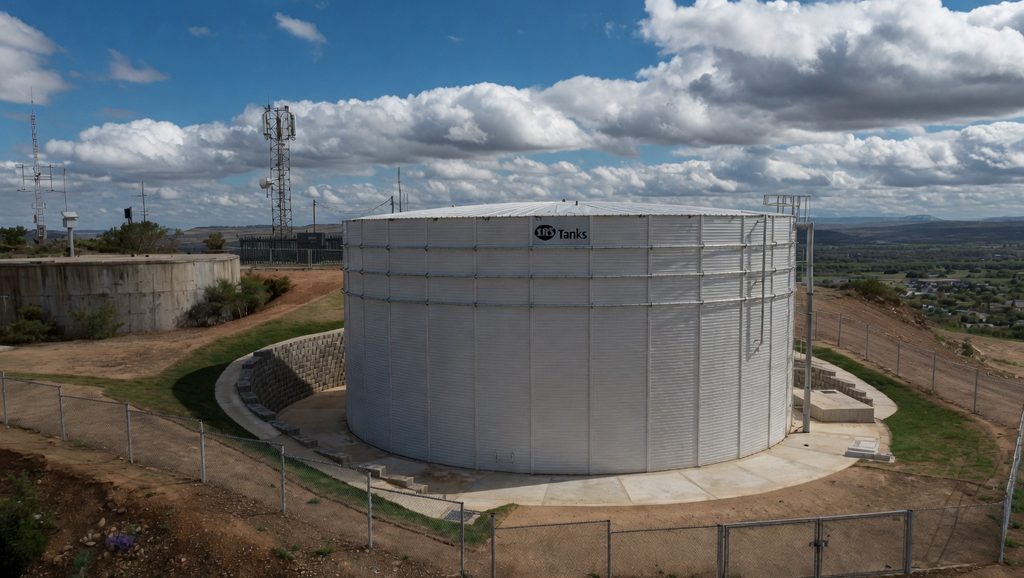
Every installation presents its own environmental challenges.
For projects located in high-wind regions, engineering decisions cannot rely solely on standard design values.
The Kirkwood Water Supply Scheme demonstrates how SBS Tanks combines engineering expertise, structural analysis and site-specific research to deliver water storage infrastructure designed for the conditions it will actually face.
Because when communities depend on reliable water storage, engineering should always be based on reality – not assumptions.
Project: Kirkwood Water Supply Scheme
Tank Model: SBS Tanks ST31/09
Capacity: 3.3 ML
Application: Municipal Water Supply
Engineering Focus: Site-specific wind loading assessment and structural reinforcement
*****************************************************************************************
SBS Tanks® is Africa’s leading manufacturer and supplier of modular steel panel water storage tanks fitted with internal liquid storage liners. With offices in Durban, Johannesburg and Cape Town, and ISO 9001 and ISO 45001 accreditation, SBS Tanks services clients across South Africa and the SADC region with engineered water storage tanks for municipal, mining, fire protection, commercial, industrial, agricultural and water conservation applications.
© SBS Holdings 2026