

Client: Orkun Group | Location: Zanzibar, Tanzania | Application: Municipal water supply
Tank: ST14/04 | Elevation: 20 m | Capacity: 301kl | Environment: Coastal
For many municipal water infrastructure projects, elevation is a critical part of the system design.
Raising a storage tank above ground level can create the hydraulic head required to distribute water through a network using gravity, reducing dependence on mechanical pumping. However, as tank elevation increases, the structural demands on the supporting system also increase.
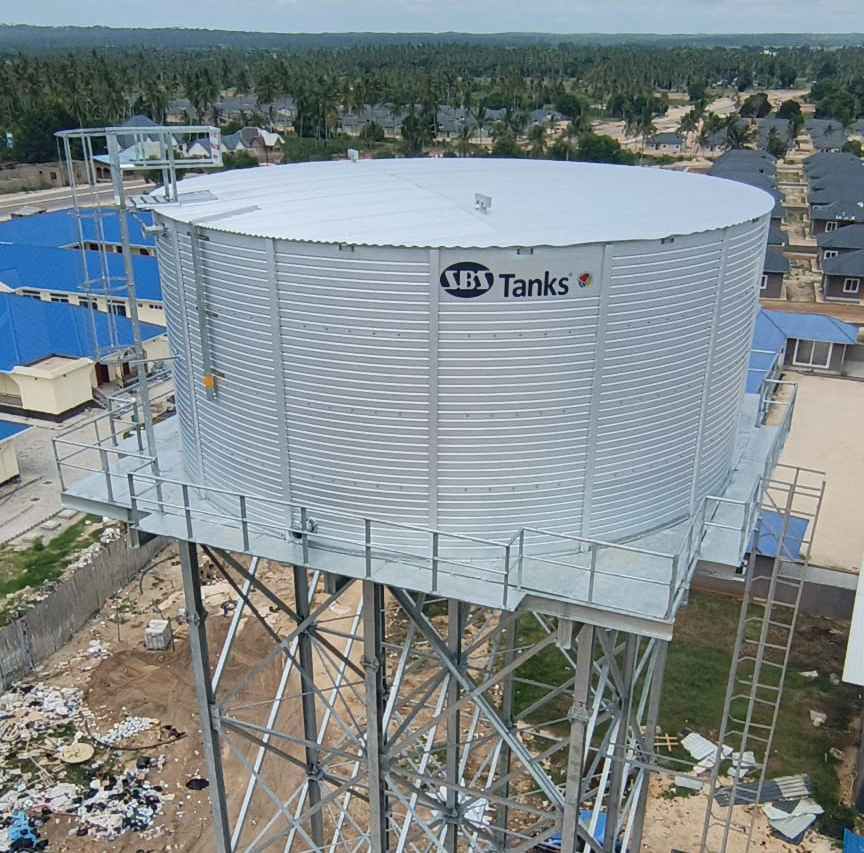
This was a key consideration for an SBS Tanks municipal water project in Zanzibar, where an ST14/04 tank was elevated approximately 20 m above ground level.
The project presented a combination of structural, environmental, logistical and installation challenges. The tank needed to be supported by a substantial steel tower in a coastal environment, while the remote location and local working conditions added further complexity to the construction programme.
The result was a project that represented a significant engineering achievement for SBS Tanks: the highest tower and largest elevated SBS tank installed in East Africa at the time.
The fundamental objective of the project was straightforward: elevate the water storage tank sufficiently to allow gravity to provide the pressure required for municipal distribution.
This approach can offer an important operational advantage. By using elevation to create hydraulic head, the system can distribute stored water without relying entirely on additional pumping equipment.
However, achieving that objective required much more than simply placing a tank on a tall structure.
The engineering team had to consider the combined weight of the tank and stored water, the substantial structural steel required for the tower, wind loading, foundation integrity and the environmental exposure associated with the tank’s proximity to the ocean.
At approximately 20 m high, the tower became a significant structural component of the overall water storage system.
The tower was designed by the engineering team in East Africa, who developed the structural design and drawings required to support the tank at the specified elevation.
The supporting structure incorporated substantial steelwork, with large beams and columns designed to carry the loads generated by the elevated tank and its stored water.
Unlike a conventional ground-supported tank, an elevated tank introduces additional structural considerations. The supporting tower must transfer vertical loads safely into the foundation while also resisting lateral forces generated by wind and other environmental actions.
The tower therefore had to function as an integral part of the water storage system.
The final design allowed the tank and tower to be assembled using bolted connections. No modifications to the tank were required during installation, demonstrating the importance of coordinating the tank, tower and supporting structural design before construction commenced.
The project’s location close to the ocean introduced another important engineering consideration: corrosion exposure.
Coastal environments can be particularly demanding for steel infrastructure because of exposure to salt-laden air and moisture. For a structure expected to provide long-term municipal service, corrosion protection therefore becomes an important part of lifecycle performance.
The tower was galvanized specifically for the coastal environment, providing enhanced corrosion resistance to the exposed structural steelwork.
The decision to galvanize the tower was particularly important given its size and accessibility. Corrosion protection at the structural support level contributes to the long-term durability of the elevated system and reduces the risk of premature deterioration.
The tank itself also incorporated SBS Tanks’ corrosion-resistant construction, making the combined system appropriate for its coastal operating environment.
Elevation increases exposure to environmental loading.
For this project, wind loading in Zanzibar was an important consideration in the structural design of the elevated tank and tower. The engineering assessment needed to account for the forces acting on the elevated structure and ensure that these loads could be transferred safely through the tower and into the foundation.
The foundation therefore required a high level of structural integrity to support the substantial steel tower together with the weight of the tank and stored water.
This illustrates an important principle in elevated water storage: the tank cannot be engineered in isolation from the structure supporting it.
The tank, tower, anchoring arrangement and foundation must work together as a continuous load path.
The client was responsible for constructing the tower foundation. SBS Tanks supported this process by providing the required foundation templates and hold-down bolts used to anchor the tower.
Unlike a conventional ground-supported SBS tank, the project did not require a tank ring beam. The foundation was designed specifically to accommodate the elevated tower structure.
Accurate positioning of the hold-down bolts was therefore critical. The tower sections had to align correctly with the prepared foundation so that the bolted installation could proceed without modification.
This early coordination between the foundation construction and tower installation helped ensure a smooth transition from civil works to structural assembly.
The engineering requirements were only one part of the challenge.
The project site was relatively remote and the tank components had to travel a complex logistics route. Materials were transported from South Africa to Dar es Salaam before continuing onwards to Zanzibar.
This required careful coordination of manufacturing, galvanizing, freight and site delivery to ensure that the required components arrived in the correct sequence.
The project also took place during Ramadan, meaning the installation team worked reduced hours. At the same time, the project experienced hot and rainy conditions associated with the local climate.
Rain created an additional operational constraint because crane operations could not continue safely during unsuitable weather conditions.
For a 20 m elevated structure, maintaining strict control over lifting operations and worker safety was particularly important.
The tower was fabricated and galvanized before being transported to site for installation.
Once the foundation was ready, the tower sections were assembled and bolted together. Crane lifting was used to position the required materials and structural components during the installation process.
The tower installation took approximately 14 days.
With the supporting structure completed, the SBS ST14/04 tank was then installed at the 20 m elevation. The tank installation was completed in approximately four days.
The entire installation process followed SBS Tanks’ standard installation methodology, supported by assembly drawings, qualified personnel, site supervision and safety procedures.
Quality control inspections were conducted during and after installation to verify that the completed structure met the required standards.
Maintaining installation quality was particularly important given the combination of height, weather and reduced working hours.
A qualified installation team was responsible for the assembly, supported by a site supervisor. Assembly drawings provided the required installation sequence and component information, while SBS site visits provided additional engineering and technical oversight.
The project demonstrated that a challenging environment does not necessarily require a fundamentally different installation methodology. Instead, disciplined application of established engineering, safety and quality-control processes allowed the team to manage the additional risks associated with the site.
Even with Ramadan working restrictions and periods of unsuitable weather, the tower and tank were installed successfully without modifications to the tank.
The client allowed approximately six months for completion of the project.
SBS Tanks completed the overall project in approximately three months.
The project programme included:
Completing the project in roughly half the allocated timeframe demonstrates the importance of coordinating manufacturing, specialist finishing, logistics and installation as a single project programme.
This was particularly significant given the additional logistical requirements of transporting the equipment through Dar es Salaam to Zanzibar and the reduced installation hours during Ramadan.
The completed elevated tank provides an important operational benefit to the municipal water network.
By storing water at approximately 20 m above ground level, the system creates the hydraulic head required to support gravity-fed distribution.
This reduces the need for additional pumping to achieve distribution pressure and can contribute to a more reliable and sustainable water supply.
The value of the project therefore extends beyond the physical tank and tower. The engineering design directly supports the operational objective of delivering water to the community through an efficient distribution approach.
The Zanzibar project demonstrates that elevated water storage requires an integrated approach to engineering.
The tank, tower, foundation, environmental conditions and installation methodology all influence the final performance of the system.
Several key considerations were particularly important:
The project also reinforced the importance of adaptability. Working respectfully within local cultural practices while maintaining engineering and safety standards was essential to successful delivery.
For SBS Tanks, the project provided valuable experience in delivering large elevated water storage infrastructure in a challenging coastal and logistical environment.
Most importantly, it demonstrated that modular construction, coordinated structural engineering and disciplined installation processes can be applied successfully to complex elevated water storage requirements.
“The engineering challenge was not simply to elevate the tank. It was to design and install an integrated tank, tower and foundation system capable of safely supporting the required water storage while operating in a demanding coastal environment.”
The Orkun Group Zanzibar project demonstrates the engineering considerations involved in elevated municipal water storage. An SBS ST14/04 tank was installed approximately 20 m above ground level on a galvanized steel tower, creating the hydraulic head required for gravity-fed water distribution. East Africa Engineering designed the tower and supporting structure, while SBS Tanks coordinated the tank installation, foundation interfaces and quality-control processes. The coastal location required enhanced corrosion protection, while wind loading, foundation integrity, lifting safety and challenging logistics were carefully considered. Despite Ramadan working restrictions, hot and rainy weather and complex freight requirements between South Africa, Dar es Salaam and Zanzibar, the project was completed in approximately three months against a six-month client programme.
Why was the tank elevated 20 m above ground level?
The tank was elevated to create sufficient hydraulic head to support gravity-fed municipal water distribution, reducing reliance on additional pumping.
What made the Zanzibar project unique?
The project involved an ST14/04 tank elevated approximately 20 m above ground level, making it the highest tower and largest elevated SBS tank installed in East Africa at the time.
Why was the tower galvanized?
The project was located close to the ocean, where salt-laden air and moisture can increase corrosion exposure. Galvanizing provided enhanced corrosion protection for the exposed tower structure.
Who designed the elevated tower?
East Africa Engineering designed the tower and provided the structural drawings required to support the tank at the 20 m elevation.
Did the tank require modifications for the elevated installation?
No. The tank was installed using the planned bolted assembly methodology without modifications to the tank.
How was the tower foundation managed?
The client constructed the foundation, with SBS Tanks providing templates and hold-down bolts to ensure the tower could be correctly anchored to the foundation.
How long did installation take?
The tower took approximately 14 days to install, followed by approximately four days for the tank installation.
What challenges affected the project?
The project involved challenging logistics to Zanzibar, Ramadan working restrictions, hot weather and rainy conditions. Rain also prevented crane operations when conditions were unsuitable.
How quickly was the project completed?
The client allowed six months for completion, but SBS Tanks completed the overall project in approximately three months.
What was the main operational benefit of the elevated tank?
The 20 m elevation provides hydraulic head that allows water to be distributed using gravity, reducing the need for additional pumping.
Elevated water storage requires careful consideration of hydraulic requirements, tank geometry, structural loading, wind exposure, foundations and installation methodology.
Speak to an SBS Tanks consultant to discuss your municipal water storage requirements, including required capacity, elevation, site conditions and distribution objectives. The SBS Tanks team can support early-stage project planning and coordinate with structural and civil engineering teams to develop an appropriate tank configuration.
SBS Tanks manufactures and installs modular bolted steel water storage tanks for municipal, industrial, mining, agricultural and fire protection applications.
With project-specific engineering, controlled manufacturing and experienced installation teams, SBS Tanks delivers water storage infrastructure designed around the operational, environmental and structural requirements of each site.
© SBS Holdings 2026