
In a fixed fire-protection system, water storage is not the same as normal backup supply. The stored volume must be available when the fire system is called on, and it must be specified around the building risk, insurer requirements, pump interface and fire-protection design.
For developers, facility managers, procurement teams and commercial property owners, the question is not only how much water is required. The more important question is whether the tank, reserve volume, outlet level, anti-vortex arrangement, pump connection and maintenance obligations align with the appointed fire protection specialist’s design.
SBS Tanks is a listed ASIB-approved supplier of fixed fire-protection water storage tanks, with products that conform to ASIB 12th Edition Rules. This guide explains what that means in practice and what project teams should confirm before specifying a fire-water tank.
Fire-water storage provides a dedicated volume of water for fixed fire-protection systems. It must be protected from normal operational use and specified according to the project fire-protection design. SBS Tanks supplies ASIB-aligned modular steel fire-water tanks for commercial and industrial projects, working with the appointed fire protection specialist to meet the required capacity, outlet configuration, pump interface and site conditions.
ASIB approval matters because fixed fire-protection systems are closely linked to insurer acceptance, compliance review and life-safety risk. Where an ASIB-aligned fire-water tank is required, the supplier must be suitable for the specification and the tank must fit into the broader fire-protection system design.
SBS Tanks is listed as an ASIB-approved supplier and supplies fire-protection tanks that conform to ASIB 12th Edition Rules. This does not replace the role of the fire engineer or fire protection specialist. The appointed specialist remains responsible for confirming the system design, required volume, fire demand, pump interface, outlet arrangement and inspection obligations.
For procurement teams, ASIB-approved supplier status gives confidence that SBS can be specified where an ASIB-aligned fire-water storage tank is required. Final acceptance still depends on the complete system meeting the project specification and insurer expectations.
Fire-water storage should be planned as part of the full fixed fire-protection system, not as a general backup-water tank. The required tank capacity, outlet level, suction arrangement, pump interface, anti-vortex requirements and inspection obligations must be confirmed by the appointed fire protection specialist, insurer and project team before procurement.
Compliance, approvals and fire-system standards
Fire-water tanks are often specified around insurer requirements, fire-engineering standards and local approval routes. In South Africa, this may include ASIB requirements, ASIB 12th Edition Rules and project-specific fire-protection specifications. For international or export projects, NFPA 22 may also apply where specified by the fire engineer, insurer or authority having jurisdiction.
Because the fire-water tank forms part of a wider fixed fire-protection system, compliance must be considered before procurement. The appointed fire protection specialist remains responsible for confirming the system design, required volume, fire demand, pump interface, outlet configuration, anti-vortex requirements and final approval path. The tank supplier must then align its scope to the approved specification.
SBS Tanks is a listed ASIB-approved supplier of fixed fire-protection water storage tanks, with products conforming to ASIB 12th Edition Rules. SBS supplies the tank element of the fire-protection system and supports project teams with tank drawings, capacity confirmation, outlet positioning, approved configuration details and handover documentation required for inspection and commissioning.
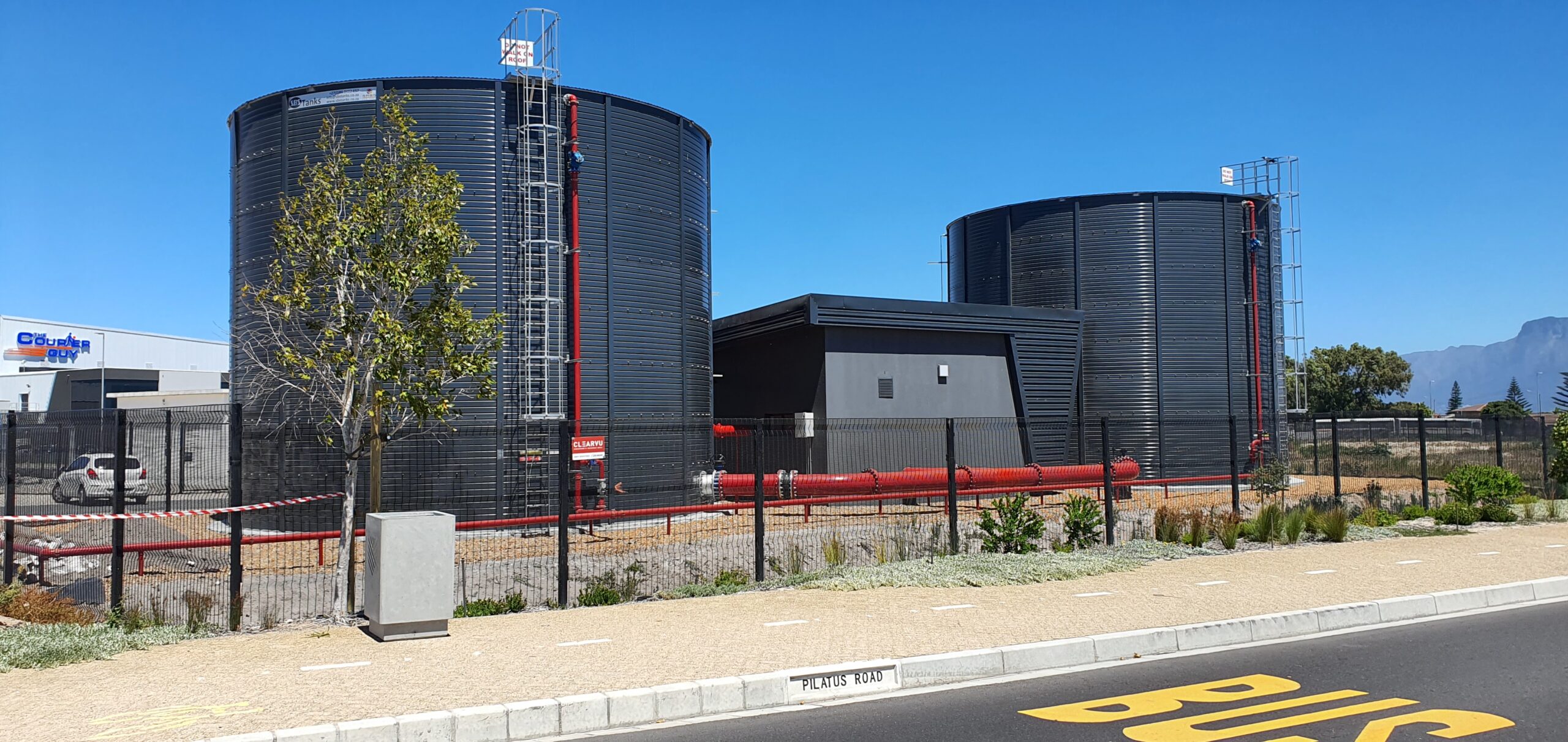
The Courier Guy twin ASIB fire-water tank project is a useful feature reference for this compliance-led approach. The project demonstrates how SBS modular steel fire tanks can support commercial property teams where dedicated fire-water storage, ASIB-aligned specification, pump interface coordination and formal fire-system approval requirements need to be planned together. Read the full Courier Guy case study online to see how SBS supported a fixed fire-protection storage requirement for a commercial logistics environment.
System demand, sizing and dedicated fire reserve
Fire-water storage volume is determined by the fire-protection design, not by normal water-use requirements. The appointed fire specialist calculates the required volume based on the building risk, hazard classification, system flow rate, required duration, sprinkler demand, hydrant or hose-reel demand and insurer requirements.
The fire reserve must remain available for emergency use and should not be depleted by normal domestic, process or operational water drawdown. Where a tank is used for more than one duty, the fire reserve must be protected through the correct outlet levels, controls and system design.
Hydraulic performance, pump suction and anti-vortex design
A fire tank must support reliable water delivery under high-flow emergency conditions. The project team should confirm outlet diameter, suction pipework, minimum operating level, pump-room interface, valve access, vortex inhibitor or anti-vortex plate requirements, overflow arrangement and refill method.
Poor suction design can affect pump performance and increase the risk of air entrainment or cavitation during a fire event. Early coordination between the fire specialist, pump supplier, tank supplier and civil team helps ensure that nozzles, outlets, penetrations and anti-vortex arrangements are positioned correctly before manufacture.
SBS tanks can be configured with project-specific nozzles, outlet levels and anti-vortex arrangements where these are included in the approved fire specification.
Site footprint, installation programme and operational constraints
Fire-water tanks are often installed on active commercial, industrial, logistics or retail sites where space, access and programme are constrained. The project team should assess available footprint, delivery access, foundation readiness, working area, proximity to the pump room, pipework route, drainage, security and future maintenance access.
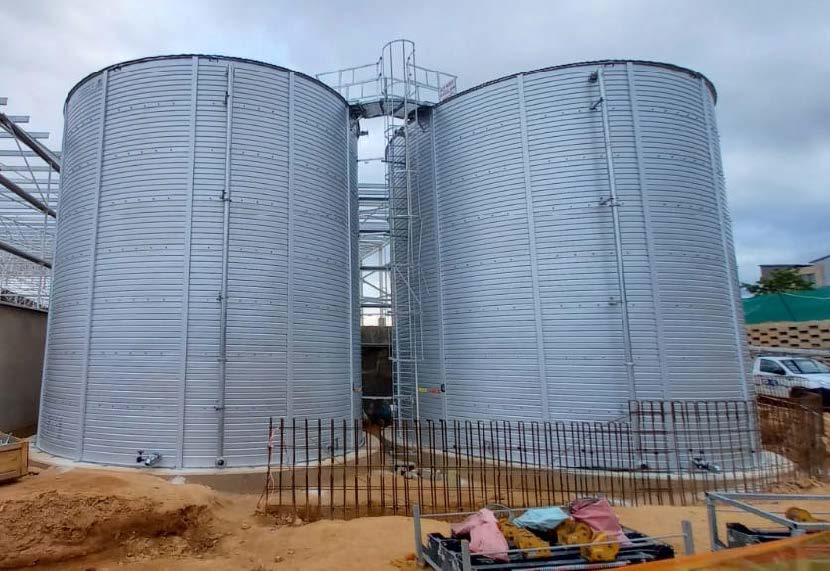
This is where modular steel tanks can be useful. Components can be manufactured off site and assembled on a prepared foundation, helping support programme certainty where fire-system commissioning is linked to building occupation, insurer approval, production start-up or operational handover.
The Germiston Data Centre project is a strong commercial fire-protection reference, where SBS supplied two fixed fire-protection tanks with a total capacity of 738kL for a datacentre development involving Fire Logik, WBHO and Logik Group Africa. For industrial and food-sector fire-water storage, SBS references include CCBSA Pretoria Fire Tanks, where two ST13/09 tanks provided 1.160ML of dedicated fire-water capacity.
Fire-water storage should be planned as a dedicated life-safety requirement, not as ordinary backup water. Capacity, outlet arrangement, anti-vortex design, pump interface, insurer expectations and maintenance obligations must be confirmed before the tank is specified.
SBS Tanks supplies ASIB-aligned modular steel fire-water tanks for commercial and industrial projects across South Africa. Contact SBS Tanks to discuss your fire-protection water storage requirement.
Fire-water tanks may hold static water for long periods, so water containment, corrosion protection and maintenance access must be planned from the start. The project team should consider stored-water quality, internal water contact surfaces, external environmental exposure, roof protection, overflow and scour arrangements, inspection access and maintenance intervals.
SBS modular steel tanks use an internal liner system that separates the stored water from the steel structure. This helps protect structural components from direct water contact and supports long-term asset planning, provided the tank is correctly specified, installed, inspected and maintained.
Facility managers should also confirm how the tank will be inspected, cleaned, drained, isolated and returned to service without compromising the fire-protection system for longer than necessary.
Fire-system demand can change when a building is extended, storage density increases, occupancy changes or new process risks are introduced. Property owners should consider whether the selected fire-water storage arrangement can support future capacity, additional pipework interfaces, changed pump requirements or phased site development.
Where site risk justifies it, dual tanks or interconnected tanks may be considered so that maintenance can be planned with reduced impact on fire-water availability. Final redundancy requirements should be confirmed by the appointed fire protection specialist and insurer
*****************************************************************************************
SBS Tanks® is Africa’s leading manufacturer and supplier of modular steel panel water storage tanks fitted with internal liquid storage liners. With offices in Durban, Johannesburg and Cape Town, and ISO 9001 and ISO 45001 accreditation, SBS Tanks services clients across South Africa and the SADC region with engineered water storage tanks for municipal, mining, fire protection, commercial, industrial, agricultural and water conservation applications.
Contact one of our sales agents today or request a quote here.
*****************************************************************************************
© SBS Holdings 2026