
A reliable municipal water supply depends on having the right storage infrastructure, in the right place at the right time. Reservoirs and bulk storage tanks sit between the source, treatment works and distribution network, helping absorb demand peaks, maintain continuity and support pressure management across communities.
When this storage layer is undersized, poorly located or ageing, the effects can move through the entire system: low pressure, supply interruptions, increased pumping strain and reduced public confidence. For municipal engineers, water boards and public-sector project teams, bulk water storage is a planning decision that affects service delivery and long-term asset performance.
Municipal bulk storage must be planned around the network it supports. The key questions are how much water must be stored?, where the storage should be placed?, what pressure the system requires?, how water quality will be protected?, and how the asset will be maintained?.
The main project inputs include demand profile, population growth, supply rate, required reserve, site access, foundation design, inlet and outlet configuration, overflow and drainage, material suitability, roof integrity, maintenance access, security and environmental exposure.
SBS modular steel tanks can support municipal projects where fast deployment, above-ground access, engineered capacity, potable-water compatibility and phased expansion are important. Final tank configuration should be confirmed with the appointed professional team and the SBS technical team.
1. Capacity, demand and reserve planning
Municipal reservoir capacity should be calculated from the full demand profile, not only the immediate storage shortfall. Engineers and planners should consider the population served, average daily demand, peak demand, future housing or commercial growth, source reliability, pumping capacity and the reserve period required during supply interruptions.
Storage also needs to balance the way municipal systems operate. Treatment works and pumps may run continuously, while community consumption often peaks in the morning and evening. Where applicable, emergency reserve, fire reserve, planned maintenance and drought resilience should also be included in the sizing assessment.
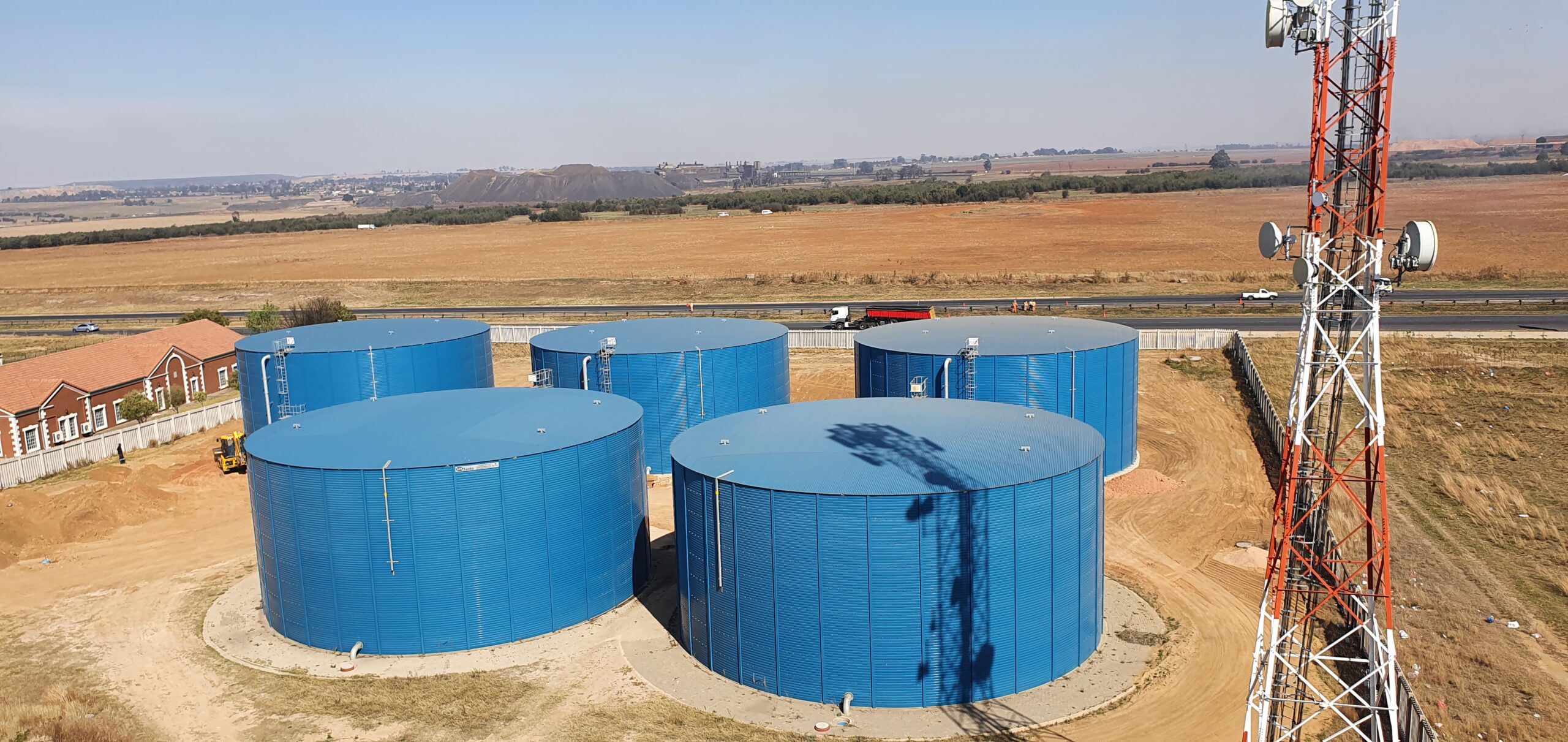
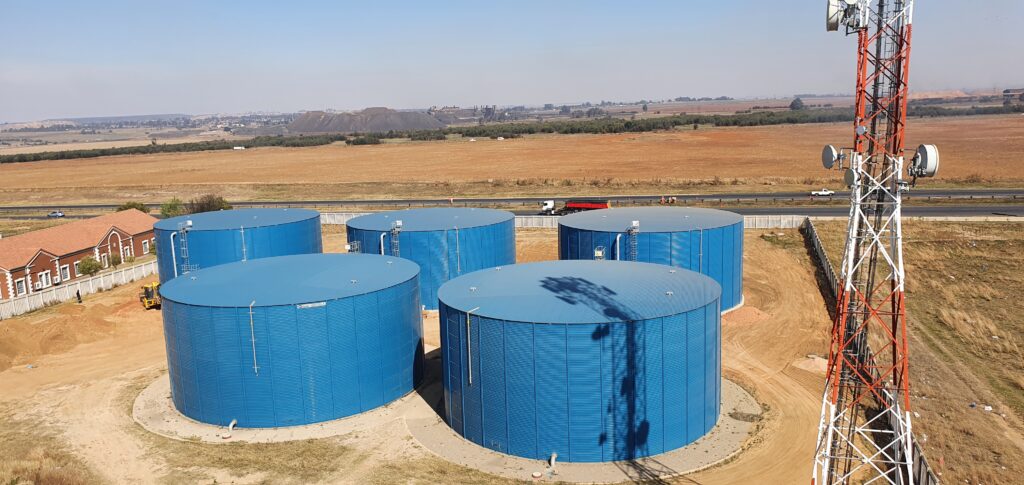
SBS municipal references range from localised supply support to multi-megalitre public water infrastructure. The Emalahleni potable water tank farm demonstrates large-scale municipal storage, with five ST31/09 tanks providing 16,5 million litres of storage.
2. Location, topography and hydraulic performance
Reservoir location affects both storage and pressure. Where possible, municipal reservoirs are often positioned on elevated ground to support gravity-fed distribution and reduce reliance on continuous pumping. This can help stabilise supply across a reticulation network, especially where communities are spread across different elevations or where pump performance and power reliability are concerns.
Where natural ground elevation is not sufficient, elevated tanks may be considered to provide the hydraulic head required for local distribution. Elevated storage can be useful for smaller towns, rural supply schemes, schools, clinics, public facilities, housing developments or service areas where gravity-assisted pressure is required but the site does not justify a large ground-level reservoir.
The project team should confirm the supply zone, required operating level, inlet and outlet levels, pump interface, overflow arrangement, pressure requirement, refill rate and whether the reservoir will feed directly into the network, balance supply from a treatment works, or support a specific development area.
SBS ground-level tanks have been used across municipal and public-sector projects where reservoir location, supply zones, site conditions and distribution requirements had to be planned together. References include Nelson Mandela Bay Metro (460,000 litres), NYEWASCO in Kenya (1 × ST26/04, 1.04ML) and Tanga UWASA in Tanzania (1 × ST26/04, 1.04ML), showing how modular steel storage can support public water infrastructure across different municipal settings, from localised supply support to regional water-service schemes.
SBS Elevated Tanks can support public-sector and municipal projects where raised storage is required to assist with pressure delivery, localised supply or distribution to a defined service area. The required height, capacity, support structure, foundation, inlet and outlet configuration must be confirmed through the hydraulic design and matched to the relevant SBS Elevated Tank range. Where suitable, elevated tanks can complement ground-level storage by supporting pressure requirements closer to the point of use.
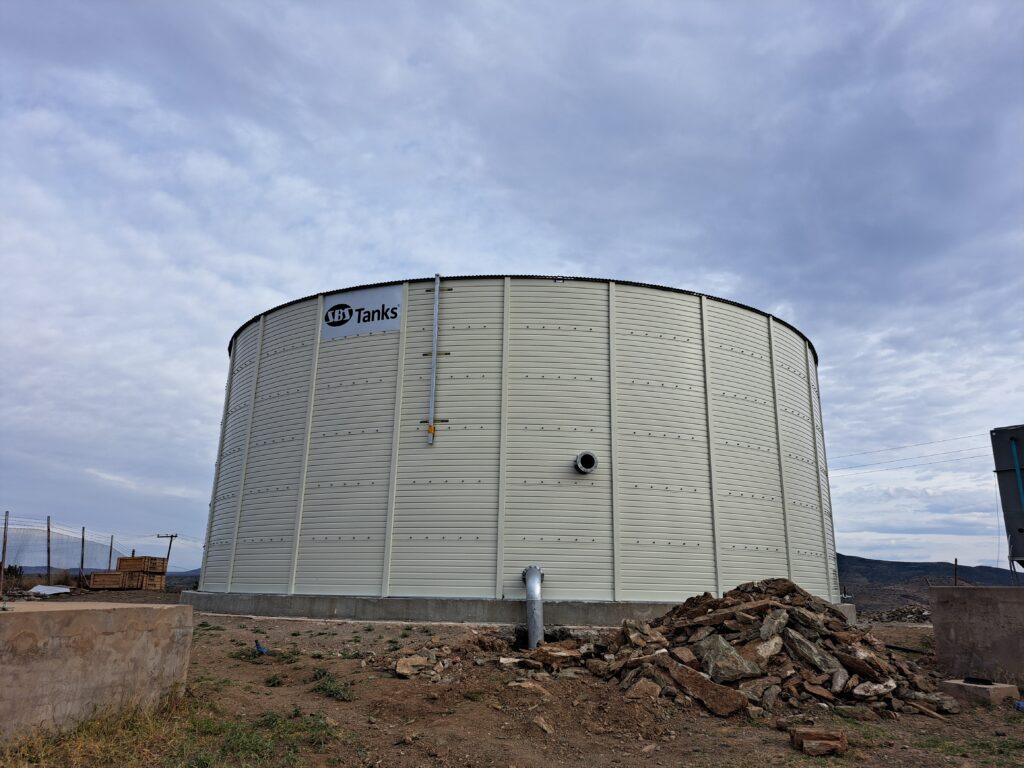
The Jansenville and Klipplaat municipal water storage projects are useful examples of rural public-sector reservoir upgrades where site planning, delivery coordination and fit-for-purpose storage capacity were central to the project. SBS supplied modular steel tanks for both towns as part of the Ikwezi Bulk Water Supply Project, helping modernise ageing water storage infrastructure and support more reliable municipal water supply. Read the full Jansenville and Klipplaat case study online to see how modular steel storage supported public water infrastructure upgrades across two rural communities.
4. Water quality, safety and material selection
For potable municipal water, the reservoir must protect stored water quality throughout its operating life. Engineers should consider water chemistry, disinfection method, turnover rate, risk of stagnation, inlet and outlet positioning, scour arrangements, screened openings, roof protection, access hatches and cleaning requirements.
Material selection is part of this decision. Concrete, modular steel, welded steel, glass-fused steel and plastic tanks all contain water differently and have different implications for construction programme, corrosion protection, maintenance, repairs, asset life and water contact surfaces. The correct choice depends on stored water quality, required capacity, site exposure, budget, maintenance capability and long-term municipal operating requirements. SBS modular steel tanks use an internal liquid storage liner that separates the stored water from the steel structure. For potable-water duties, liner suitability, inlet and outlet arrangements, overflow, scour, access and cleaning requirements should be confirmed during specification.
Municipal water infrastructure is not limited to potable storage. Where municipalities are also planning wastewater, effluent or treatment-related storage, the specification changes significantly. The project team must consider pH, chemical exposure, solids content, temperature, aeration requirements, odour control, corrosion risk, liner or coating compatibility, stainless-steel fittings and maintenance access. These applications should be assessed separately from potable reservoir storage because the stored liquid and operating environment place different demands on the tank system. SBS wastewater references, including the Klomac wastewater treatment project, show how modular steel tanks can be configured around specialist liner, fitting and process-interface requirements for treatment-related duties.
6. Compliance, documentation and long-term asset management
Public-sector water infrastructure must be planned with compliance, procurement, quality assurance and handover in mind. Municipalities should confirm what documentation is required before manufacture or construction begins, including approved drawings, material specifications, quality control records, inspection records, installation records, commissioning documents, warranties and maintenance requirements.
Auditability is especially important on public-sector projects. The selected reservoir type should give engineers, procurement teams and asset managers confidence that the supplied infrastructure can be checked against a defined specification, inspected at key stages and handed over with the correct supporting documentation. This includes manufacturing quality records, traceable components, inspection hold points, installation checks and final commissioning records.
The selected reservoir type should also support long-term asset management. This includes inspection access, repairability, corrosion protection, cleaning requirements, maintenance planning, future upgrades and lifecycle cost – not only the initial construction price.
Concrete reservoirs remain a familiar municipal infrastructure option, especially where site-specific civil design favours in-situ construction, buried storage or heavy civil integration. Modular steel tanks offer a different delivery route, with components manufactured off site, inspected through controlled production processes and assembled on a prepared foundation. This can make the process more repeatable, auditable and easier to document for municipal handover.
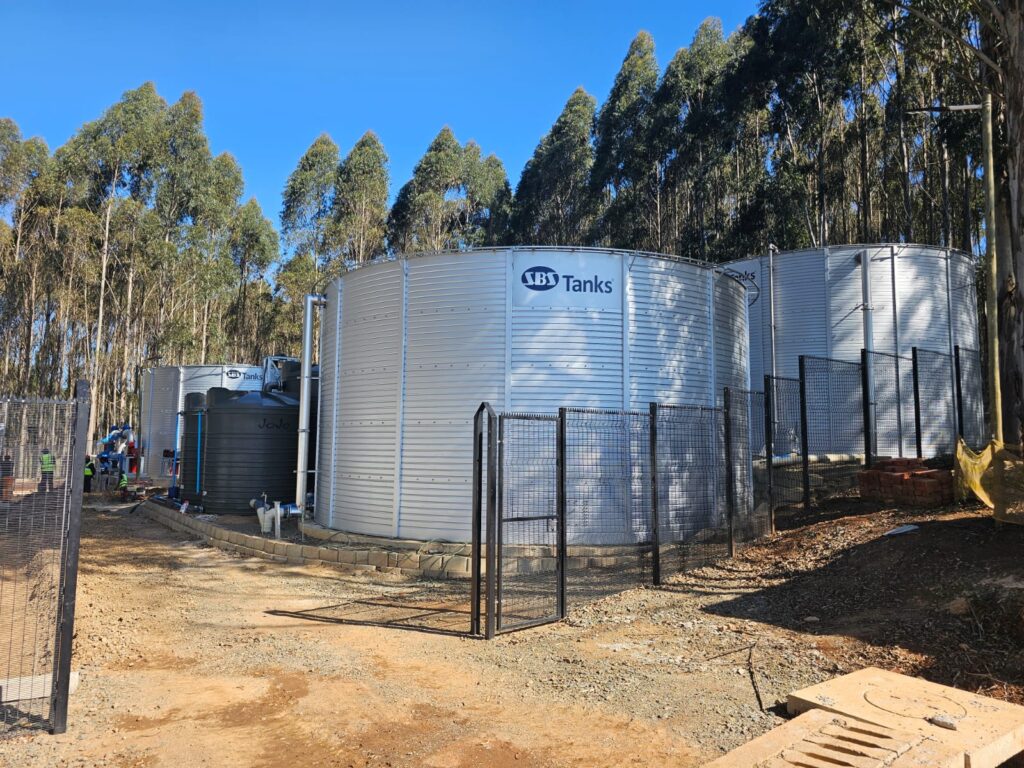
The Kirkwood municipal reservoir project is a useful reference for public-sector delivery, where programme pressure, site constraints, factory and site co-ordination, and formal project handover all had to be managed as part of a critical water infrastructure project.
For public-sector teams, the comparison should consider programme, footprint, site access, water quality, construction risk, inspection access, maintenance, documentation, future expansion, operational continuity and long-term value.
Municipal bulk water storage is a critical layer in public water infrastructure. Capacity, pressure, water quality, site readiness, project delivery, future growth, maintenance access and long-term asset management should be planned together so that the storage asset supports both immediate service delivery and long-term resilience.
The best reservoir choice is not only a question of storage volume or initial construction price. Municipalities and project teams should compare the full duty of the asset, including hydraulic role, source reliability, site access, construction programme, documentation requirements, maintenance isolation, water quality protection and future expansion.
For municipalities managing both potable water and wastewater infrastructure, SBS can also support separate treatment-related storage requirements where the stored liquid, liner system and fittings must be matched to the application.
Capacity should be confirmed by the appointed professional team using local demand data, population projections, supply rates, pumping capacity, required reserve period, pressure requirements and continuity objectives.
Yes. SBS Elevated steel tanks can support gravity-assisted pressure where the hydraulic design requires raised storage. Height, capacity and outlet configuration should be determined by the project engineer.
Modular steel tanks are manufactured off site and assembled on a prepared foundation, which can reduce time on site compared with many in-situ concrete reservoir projects. Final timelines depend on tank size, foundation readiness and site conditions.
Potable municipal storage should use a liner suitable for drinking-water contact and the project water quality profile. The correct liner, fittings and tank configuration should be confirmed with SBS during specification.
Yes. SBS municipal references include Nelson Mandela Bay Metro, Jansenville and Klipplaat, Kirkwood and KwaGuqa, ranging from localised municipal storage to multi-megalitre potable water tank farms.
Very minimal maintenance. Maintenance should include planned inspections of the roof, liner, fittings, access systems, external structure, drainage and foundation area. Any internal entry must follow confined-space safety procedures.
*****************************************************************************************
SBS Tanks® is Africa’s leading manufacturer and supplier of modular steel panel water storage tanks fitted with internal liquid storage liners. With offices in Durban, Johannesburg and Cape Town, and ISO 9001 and ISO 45001 accreditation, SBS Tanks services clients across South Africa and the SADC region with engineered water storage tanks for municipal, mining, fire protection, commercial, industrial, agricultural and water conservation applications.
Contact one of our sales agents today or request a quote below.
*****************************************************************************************
© SBS Holdings 2026