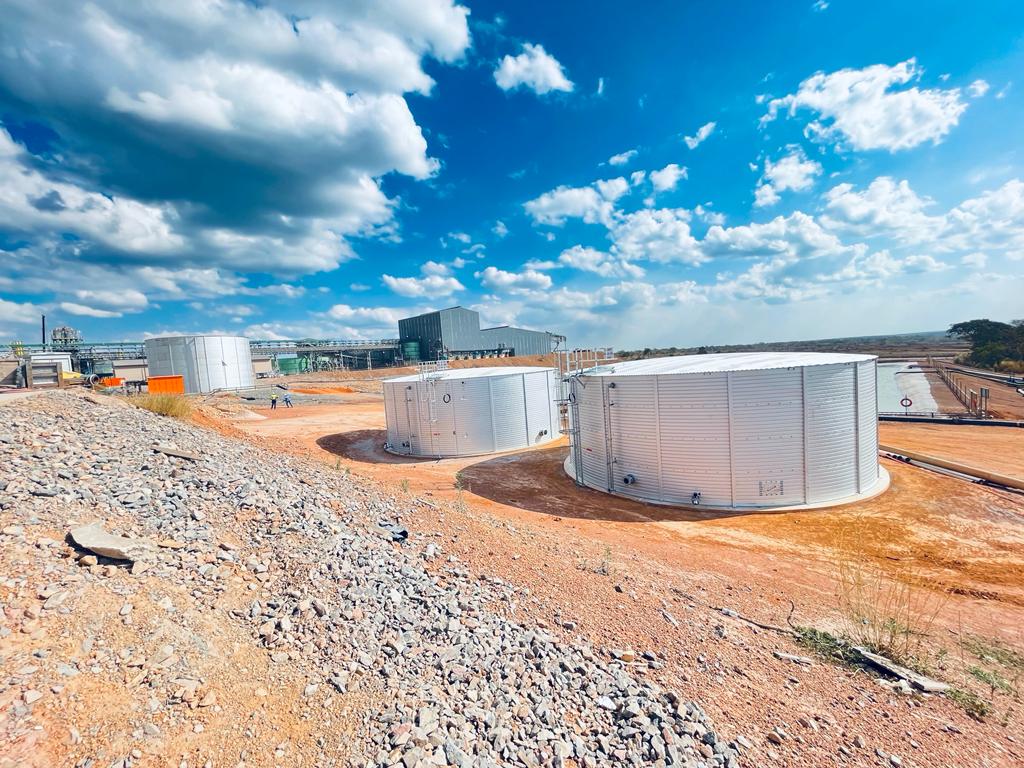

Mines can recover from many operational disruptions, but when water supply fails, production throughput, safety systems and site services can be placed under immediate pressure. Mineral processing, dust suppression, potable supply for workers, effluent management and emergency reserves are not peripheral services, they are part of the operating infrastructure that keeps a mine functional, compliant and productive. If storage is undersized, poorly located or incorrectly specified, the impact can be felt across the operation.
For mine engineers, Engineering, Procurement, and Construction Houses (EPC’s) and procurement teams, water storage should be planned by application. Each use has its own volume calculation, liquid-quality requirement, liner consideration, pipework interface, access requirement and operational risk profile.
Mining water storage is rarely one single requirement. Most mine sites rely on several applications working together, including mineral processing water, dust suppression water, potable water, treatment-related or effluent storage, emergency operational reserve and fixed fire-water storage where required.
The main project inputs include required volume, supply reliability, stored-liquid chemistry, tank application, pipework sizes, refill method, site access, foundation readiness, environmental exposure, maintenance access and any project-specific compliance requirements.
SBS Tanks supports mining projects with modular steel tank systems that can be configured around the application, stored-liquid profile, remote-site logistics, foundation readiness, pipework requirements and project programme.
Mineral processing water is used in production activities such as crushing and screening, grinding, flotation, leaching, slurry movement, washing, separation and treatment. Because it is directly linked to throughput, the storage requirement must reflect the process water balance, make-up water demand, recirculation rate, pump capacity, source reliability and required autonomy between supply cycles.
Water chemistry is often the critical design input. Reagents, suspended solids, dissolved salts or process-affected water can influence storage vessel selection and fitting requirements. SBS tanks can be specified with internal liner systems matched to the stored liquid and duty, subject to the final project specification and liquid profile.
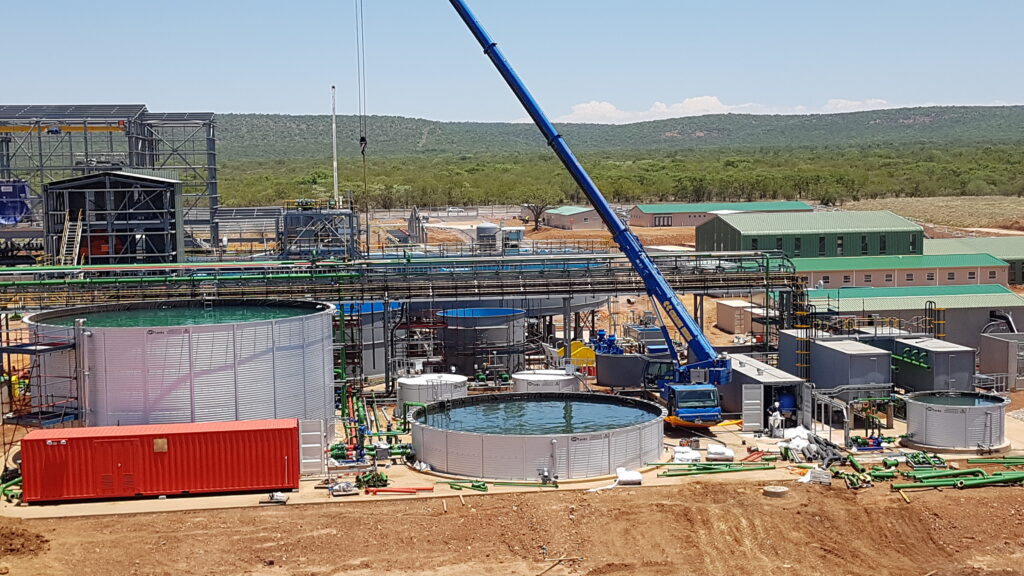
A practical example is the Hwange Colliery wash plant project in Zimbabwe, where SBS Tanks and Mazano Bio-Water delivered a 1.2ML ST23/06 tank to store clarified underground water for the mine’s new coal wash plant. The tank became the holding point between the mine’s water source and the processing plant, helping ensure that clean water was available for production when required. Read the full Hwange Colliery case study to see how modular steel storage supported plant commissioning, throughput and operating efficiency.
This application is also reflected across other SBS mining references, including process water and hot/cold well storage at Bakubang Platinum Mine, raw water for the Gangama crusher plant, borehole, clarified, raw and filtered water storage at Nokeng Fluorspar, and process water storage for the plant at Unki Mine. Together, these projects show how modular steel tanks can support mineral processing and plant water applications where reliable storage is directly linked to production continuity.
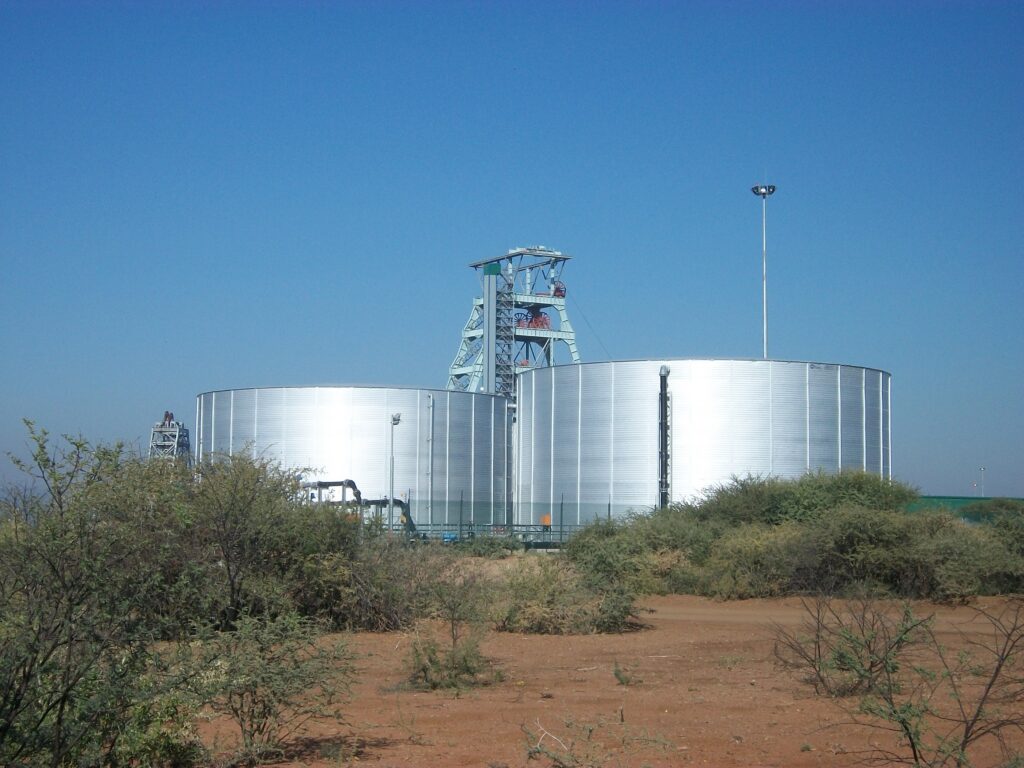
Dust suppression water is used to control dust from haul roads, blasting areas, stockpiles, crushers, conveyors and exposed working areas. It supports visibility, worker health, environmental management and licence compliance.
Storage volumes should not be based only on average daily use. Engineers should consider dry-season demand, haul-road length, operating hours, refill frequency, evaporation, pump capacity and interruptions to the water source. SBS modular steel tanks can be positioned near key operational zones or refill points to support reliable dust suppression supply.
SBS has supported dust-control and wash-plant-related storage applications on mining projects such as Kangala Coal Mine in Delmas, South Africa, where three ST31/06 tanks with a combined capacity of 6.618ML were installed for PCD evaporation holding, dust control and wash plant use. This demonstrates how bulk modular steel storage can support dust management and plant operations where water availability is linked to environmental control and daily operating continuity.
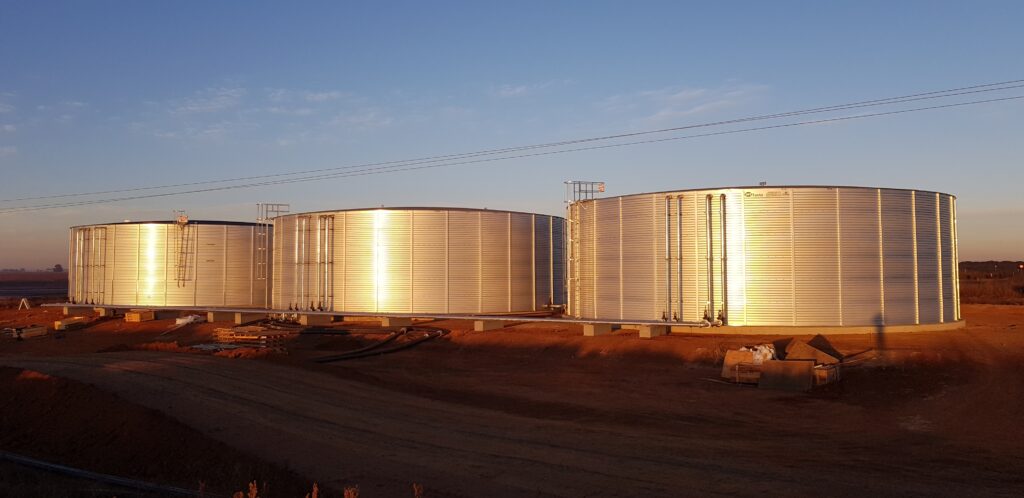
Mine sites with permanent or temporary workforces require potable water for drinking, hygiene, kitchens, accommodation, ablutions and welfare facilities. On remote sites, potable storage is a health and safety requirement as much as an infrastructure imperative.
Design inputs include workforce size, shift patterns, accommodation demand, treatment requirements, required days of backup, hygienic storage conditions, screened openings, roof integrity and access for maintenance. SBS potable liner material is approved to NSF/ANSI 61 and AS/NZS 4020:2018 drinking water standards, supporting potable water storage where the correct liner and project specification are confirmed.
The Ethiopia Kurmuk Gold Mine case study is a strong reference for remote mining-camp water storage. SBS supplied potable water storage for the mine’s camp infrastructure, with a protected fire-water reserve incorporated into the same project. Read the full Kurmuk Gold Mine case study online to see how potable supply, workforce welfare and emergency-readiness storage were addressed on a remote mining project.
SBS mining references also include potable water storage for office buildings at Perseus Mining and Aykem Mine in Ghana, potable water storage for the plant at Bogoso Gold, and multi-use storage including potable water at Kamoa Kakula Copper and Nokeng Fluorspar. These references show how potable water storage forms part of broader mine-site infrastructure, from offices and admin facilities to camp supply and plant support.
Treatment-related storage is used to hold process-affected water, effluent, leachate or contaminated water before treatment, reuse or controlled discharge. This application is often driven by environmental obligations, Water Use License requirements, reuse targets and the chemistry of the stored liquid.
The most important design consideration is compatibility. The project team should provide a water chemistry profile, expected solids content, temperature range, pH, chemical exposure and cleaning requirements. Tank designers also need to consider inlet and outlet configuration, backwash requirements, sludge movement, internal corrosion protection, access systems and any fittings that may require stainless steel, thermoplastic coating or other compatible materials.
The Nkomati Mine effluent treatment project is a strong example of this application in practice. SBS Tanks supplied three lined modular steel tanks with a combined capacity of approximately 1.843ML for the mine’s effluent treatment plant, including a wastewater tank, product tank and raw water tank. The project included specialised liner selection, including an XR5 chemical-resistant liner, as well as engineered nozzles, deflector plates, plascoated fittings and stainless-steel access components to suit the demanding treatment environment.
Read the full Nkomati Mine effluent treatment case study to see how SBS Tanks supported a mining restart project where water treatment, environmental compliance and engineered storage had to work together.
SBS mining references also include treatment and clarified-water applications such as the Aquarius Plant clarifier buffer tank, the Exxaro Mine water purification plant in Belfast, RSA, Anglo Mafube Colliery’s clarified process water tank, and the Nokeng Fluorspar clarified, raw and filtered water storage tanks. These projects show how modular steel storage can support mining water treatment duties where liquid compatibility, containment performance and plant integration are critical.
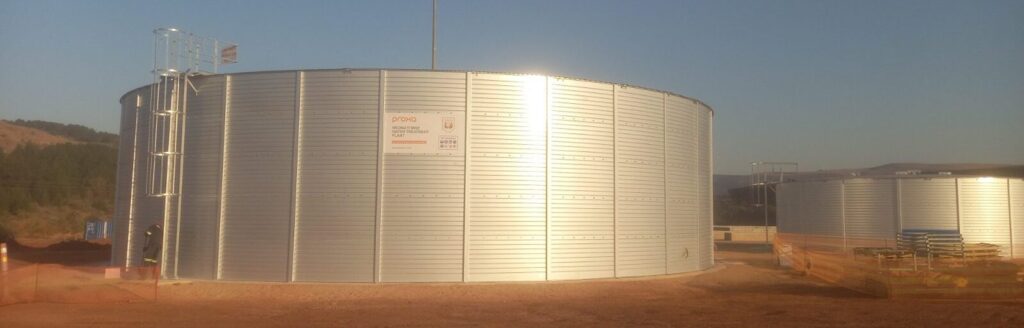
An emergency operational reserve gives the mine a buffer against supply interruptions, pump failures, pipeline incidents or delayed water deliveries. It protects continuity when the primary water source or transfer system is disrupted, especially on remote sites where response times, water delivery cycles or repair access may be difficult to control.
Reserve volume should be set by the project engineer using source reliability, repair response time, production criticality, refill capacity and site risk. It should also be planned in relation to the mine’s other water storage uses, including process water, potable water, dust suppression, wash plant water and treatment-related storage. The aim is to ensure that critical activities are not immediately exposed when the normal supply route is interrupted.
Operational reserve is often built into the broader mine water storage design rather than labelled as a separate emergency tank. SBS mining references such as Subika Gold in Ghana, Kamoa Kakula Copper in the DRC and Nokeng Fluorspar in South Africa show how storage for process, potable, raw, clarified and fire-water uses can be planned together to strengthen site resilience. These projects demonstrate why mine storage should be designed around operational risk, not only normal daily consumption.
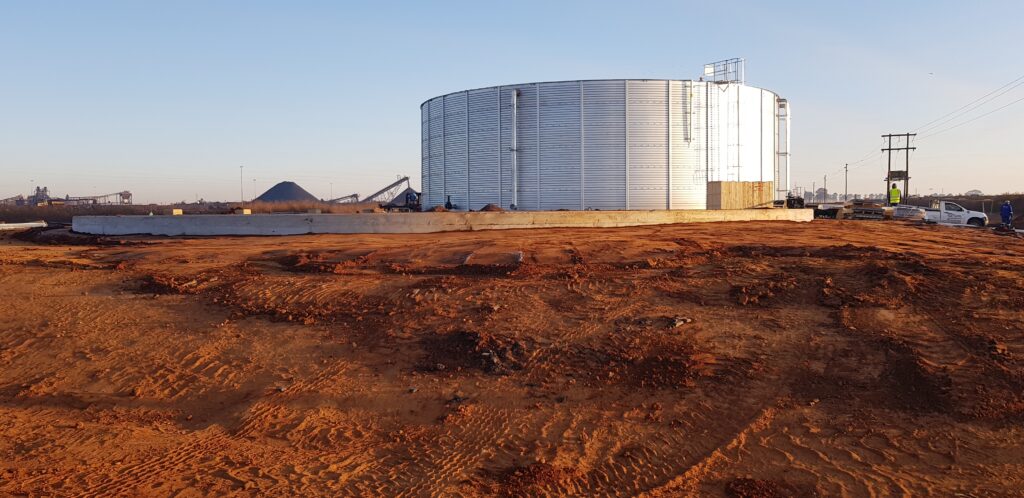
Where fixed fire protection is required, fire-water storage must be treated separately from normal operational water use. The fire reserve should remain available for emergency use and should not be depleted by process, potable or dust suppression drawdown.
The required volume, outlet level, anti-vortex arrangement, pump interface and maintenance obligations should be confirmed by the appointed fire protection specialist or project engineer. SBS can supply ASIB-aligned fire-water tanks and can configure tanks for protected fire reserve requirements where specified.
SBS mining fire-water references include Kamoa Kakula Copper in the DRC, where tanks supported process, potable and fire-water storage for underground operations and administration buildings, as well as a separate Kamoa Copper plant project with dedicated fire-water tanks. SBS has also supplied fire-protection water storage for South African mining operations including Impala UG2, Aquarius K1.5 and K2.5 UG2 Plant, and EPL UG2 Plant. These references show how fixed fire-water storage can form part of broader mine-site infrastructure while still being specified and protected separately from normal operational water use.
| Water application | Key storage consideration | Relevant SBS capability |
|---|---|---|
| Mineral processing water | Volume should reflect process demand, make-up water, recirculation, pump capacity and supply reliability. Liquid chemistry and solids may affect liner and fitting selection. | Modular lined steel tanks can be configured for process and plant water storage in capacities from 12 kL to 5.2 ML, with liner options tailored to the stored liquid and project duty. |
| Dust suppression | Capacity should allow for dry-season demand, haul-road length, operating hours, refill cycles, evaporation and source interruptions. Tank position should support refill logistics. | Modular steel tanks can be installed near haul roads, wash plants or refill points to support a reliable dust-control water supply. |
| Potable water | Storage should consider workforce size, accommodation, shift patterns, treatment needs, backup days and hygienic storage requirements. | SBS potable liner material is approved to NSF/ANSI 61 and AS/NZS 4020:2018, supporting drinking-water storage where specified. |
| Treatment and effluent | Specification should be based on pH, chemical exposure, solids, temperature, cleaning requirements and the treatment cycle. Liners and fittings must suit the liquid profile. | SBS tanks can be specified with project-specific liners, chemical-resistant options, compatible fittings and engineered nozzles. |
| Emergency reserve | Reserve volume should reflect source reliability, repair time, production criticality, refill capacity and overall site risk. | Modular steel tanks can be scaled and positioned around the mine’s continuity requirements and site layout. |
| Fixed fire-water | Volume, outlet level, anti-vortex arrangement, pump interface and maintenance obligations should be confirmed by the fire specialist. The fire-water reserve must be protected from normal drawdown. | SBS can supply ASIB-aligned fire-water tanks and configure protected fire-reserve arrangements where specified. |
Water storage on a mine should be planned by application, not treated as a single general tank requirement. Mineral processing, dust suppression, potable supply, treatment-related storage, emergency reserve and fire-water storage each carry different operational, technical and compliance considerations.
SBS Tanks can support mining project teams with modular steel tank systems configured for the required application, site conditions, stored-liquid profile and project programme. Contact SBS Tanks to discuss your water storage requirements.
Yes. Modular steel panel tanks can be transported in components and erected on prepared foundations, making them practical for remote or constrained mining sites where access and logistics need to be planned carefully. Tank components are packaged in boxes, pallets, bundles and loose pipework which not only allows for road, sea and airfreight options, but the knock-down form allows for last-mile delivery to remote sites in smaller packages.
Storage should be calculated by application: process water, dust suppression, potable supply, treatment-related storage, emergency reserve and fire-water where required. Final sizing should be confirmed by the appointed professional team using demand, source reliability, pump capacity, water chemistry and operational risk.
Liner selection depends on the stored liquid. Potable water, process water, effluent, leachate and chemically demanding applications have different requirements. A liquid specification or water chemistry profile should be provided during the enquiry phase.
Yes, where the tank is specifically designed so that the fire reserve remains protected from normal drawdown. Outlet levels, anti-vortex arrangements and pump interfaces must be confirmed in the project specification.
Installation depends on tank size, site access, foundation readiness, weather, labour availability and project scope. Current range is between 3 days (12kl tank) to 28 days (5.2Ml tank). Early co-ordination helps align manufacture, delivery, installation and commissioning with the mine programme.
*****************************************************************************************
SBS Tanks® is Africa’s leading manufacturer and supplier of modular steel panel water storage tanks fitted with internal liquid storage liners. With offices in Durban, Johannesburg and Cape Town, and ISO 9001 and ISO 45001 accreditation, SBS Tanks services clients across South Africa and the SADC region with engineered water storage tanks for municipal, mining, fire protection, commercial, industrial, agricultural and water conservation applications.
*****************************************************************************************
© SBS Holdings 2026