
For water storage tanks, environmental loading frequently becomes the governing structural design criterion rather than storage volume. While hydraulic requirements determine capacity, wind loading influences shell stability, roof truss design, anchoring systems, foundation design and overall structural resilience.
This is particularly relevant in coastal, cyclone-prone and high-exposure environments where extreme wind events can impose significant lateral, uplift and overturning forces on storage infrastructure.
Whether supporting municipal water supply, mining operations, fire protection systems or industrial processes, water storage tanks must be engineered to withstand site-specific environmental conditions throughout their design life.
Wind loading is one of the most important structural design considerations for water storage tanks. Engineers evaluate wind speed, terrain, exposure, tank geometry and operating conditions to determine design loads. Water level significantly affects stability, with empty tanks often representing the critical design condition. High wind and Cyclonic tank designs incorporate additional reinforcement, anchoring and structural stiffening to withstand extreme weather events. Wind rings are used to improve shell stability on larger tanks or in high-wind regions. Proper engineering design, environmental assessment and site-specific loading calculations are essential for long-term structural resilience.
Wind loading on cylindrical structures extends beyond a simple horizontal force acting on the tank wall.
Engineers must evaluate the combined effects of:
Design calculations typically consider:
The resulting loads influence shell reinforcement, wind girts, anchoring systems, foundation requirements and roof design.
For larger tanks, environmental loading often dictates the structural design long before detailed component selection begins.
One of the most overlooked aspects of tank design is the effect of operating water levels on structural stability.
A full tank benefits from the stabilising mass of the stored liquid, increasing resistance to uplift and overturning forces. During low-level or empty operating conditions, this stabilising effect is reduced significantly.
Engineers therefore assess multiple load cases, including:
In many cases, the empty tank condition becomes the critical design case for anchoring and uplift resistance.
Not all projects require the same environmental design parameters.
Cyclonic designs are developed for regions exposed to tropical storms, cyclones and hurricane-force wind events.
Engineering enhancements may include:
Selection should always be based on project-specific environmental assessment rather than capital cost considerations.
Wind rings are circumferential stiffening members used to improve shell stability under wind-induced loading.
They are typically considered when:
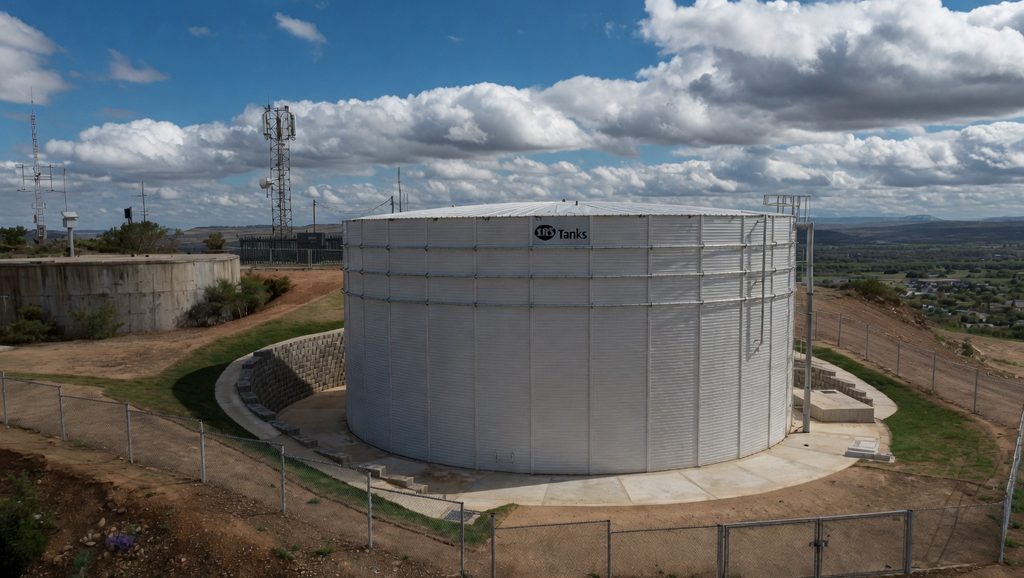
The Kirkwood Municipal Water Supply Project in South Africa demonstrated how engineered wind ring reinforcement can be successfully incorporated to enhance structural resilience following exposure to extreme wind conditions.
Structural failures rarely result from a single design deficiency.
Common contributing factors include:
Engineering investigations consistently show that properly designed and maintained storage infrastructure performs exceptionally well under severe environmental loading.
Designing storage infrastructure for high wind and cyclone prone regions requires consideration of both static and dynamic loading effects, including gust factors, fatigue loading, uplift resistance and long-term structural performance.
At SBS Tanks, environmental loading assessments form part of the engineering review process used to evaluate project-specific wind conditions, structural requirements and long-term asset resilience.
Ultimately, successful wind-resistant design is achieved through the integration of environmental loading analysis, structural engineering and operational requirements. The objective is not simply to withstand extreme weather events, but to maintain safe and reliable operation throughout the asset’s lifecycle.
Wind loads generate lateral forces, uplift, suction pressures and overturning forces that influence the design of the tank shell, roof, anchoring system and foundation.
Stored water acts as stabilising mass. Empty or partially filled tanks have reduced resistance to uplift and overturning forces, making them more vulnerable during extreme wind events.
Cyclonic tanks incorporate additional structural reinforcement, anchoring and stiffening to withstand significantly higher wind speeds than standard designs.
Wind rings are typically used on larger diameter tanks, in high-wind environments or when structural analysis indicates additional shell reinforcement is required.
Common causes include inadequate anchoring, foundation deficiencies, underestimated wind loads, insufficient reinforcement and weather events exceeding original design criteria.
Yes. Through site-specific engineering calculations, reinforced structural systems, anchoring and environmental design considerations, steel tanks can be engineered to withstand severe cyclonic conditions.
© SBS Holdings 2026